Jane Elizabeth Curran
- Born
- 5 Dec 1871
- Died
- 5 Jan 1931
- Gender
- Female
- Place of migration
- Migrated to New York/Born in Ireland
Wife of John Francis Oxton, Jr.
Devout Irish Roots
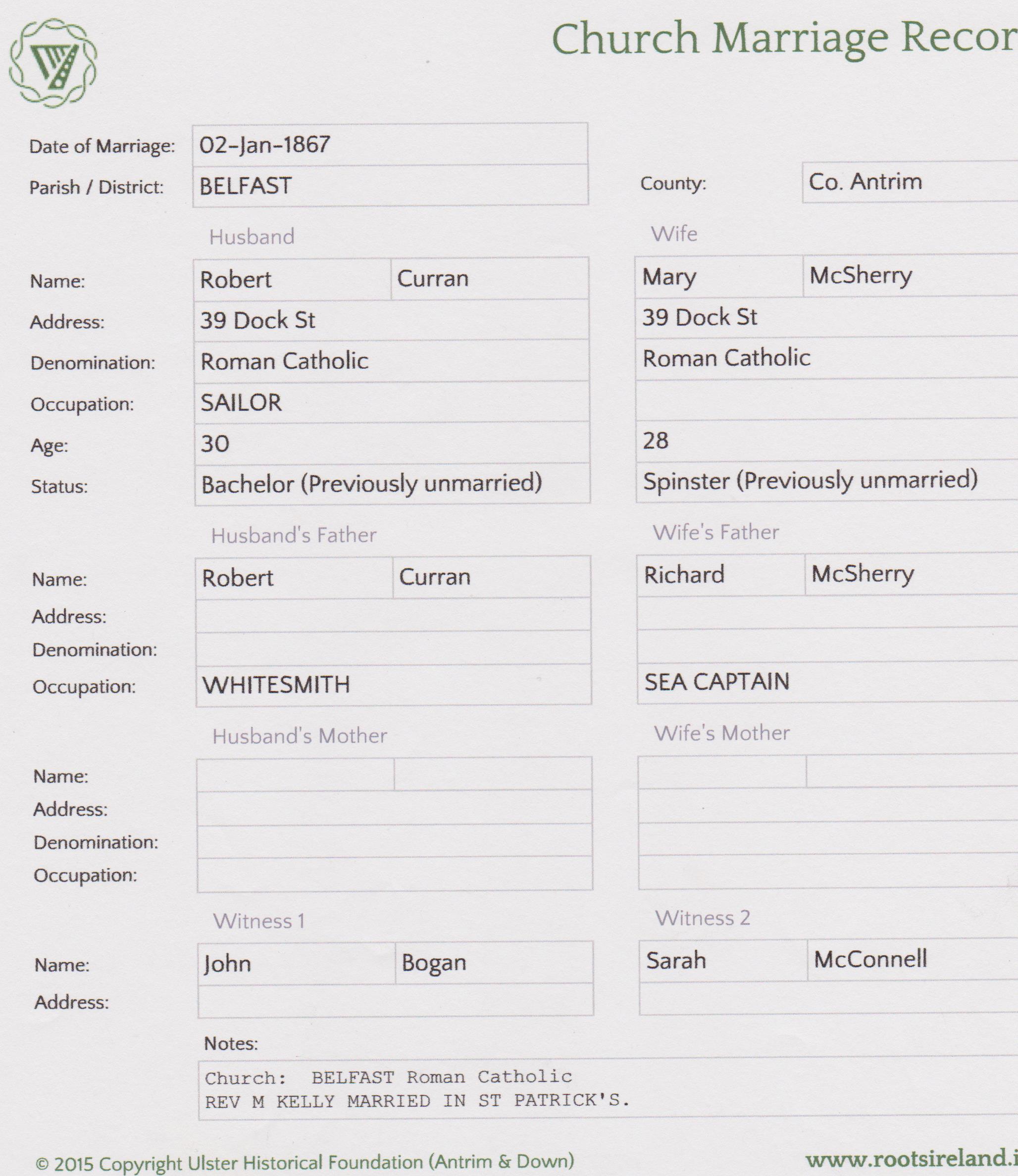
Jane Elizabeth Curran was born on 5 December 1871 at 15 Corporation Square, Belfast, Antrim, Ireland, and she was baptised on 7 Dec 1871 at St. Patrick’s Catholic Chapel in Belfast, Ireland, (where her parents were married just a few years earlier, and likely where they also were baptized) By Rev. J McCann; Jane Elizabeth's Godparents/Sponsors were Patrick McKenna and Sarah McConnell (Sarah McConnell was also listed as the Bride’s Witness-at Jane Elizabeth's parents (Mary McSherry and Robert Curran, Jr.) wedding on 2 Jan 1867 at St. Patrick’s Catholic Chapel in Belfast).
Jane Elizabeth was born into a devout Irish-Catholic family deeply tied to the sea and the tavern/public house trades. Her maternal grandfather, Captain Richard McSherry (c.10 Jun 1806–3 Sep 1887), a Publican and Sea captain/Master Mariner from Killough, County Down, had established thriving businesses in Belfast in the mid-1800s. Captain McSherry first opened the Killough Tavern at 20 Gamble Street/58 Tomb Street in Belfast's Sailortown district, before purchasing a three-story Hotel and Public House opposite the Belfast Harbour Office, located at 15 Corporation Square in Belfast, known as the Harbour Arms Hotel and Tavern. This establishment became both a commercial success and the center of family life for the McSherry, Curran, and Adair families. It was here that Jane Elizabeth and her 8 siblings were all born and spent their childhoods, surrounded by the bustle of the harbor and the flow of sailors, merchants, and travelers passing through Belfast, often visiting the eastern County Down villages of Portaferry and Killough where Jane Elizabeth's parents' respective families lived, and where her parents were born and raised.
Her early years were shaped by the realities of life for Belfast’s Irish Catholic working class. Catholics in the city faced systemic discrimination and economic hardship under British rule, often restricted to lower-paying labor, trades, and service work. Families lived in crowded neighborhoods, balancing precarious employment with the demands of child-rearing and household survival. Religious devotion, extended family networks, and strong community bonds provided crucial support and identity amid these pressures, planting the seeds for her later involvement in Irish Nationalism.
Despite these challenges, Belfast’s Irish Catholic families maintained rich cultural traditions and a strong sense of heritage. Faith was central—attending Mass and participating in parish life were acts of both devotion and cultural preservation. Jane Elizabeth’s upbringing in this environment instilled in her resilience, resourcefulness, and a deep commitment to family and Irish identity.
Family Tragedy and a Move to Liverpool
Jane Elizabeth’s father, Captain Robert Curran, Jr. (born on 16 Mar 1836 in Portaferry, County Down), followed the family tradition as both Mariner/Sea Captain and Publican. His sudden death on 8 June 1890 in an accident (known today as 'dry drowning') aboard his vessel, The Leona of Belfast, which was moored at Sligo Quay at the time, profoundly altered the family’s course.
At nearly 21, Jane Elizabeth was the eldest of six surviving (9 in total) children, her youngest sibling being age 6 or 7. Her widowed mother, Mary McSherry Curran (born 18 Mar 1838 at Ballymacarrett, County Down, to Mary Adair and Capt. Richard McSherry of Killough, County Down), faced the daunting task of providing for the family. In early 1891, Mary sold the Harbour Arms and moved her children to Liverpool, where her maternal Irish-Catholic relatives, the Adairs and Larkins, could offer support. Yet hardship followed. Sadly, their efforts to rebuild were cut short once again when Mary herself died on 30 Aug 1894 from Tubercular Bronchitis at their residence at 78 Prescott Street in the West Derby suburb of Liverpool (Present at Mary's death was her cousin Ellen Larkin (nee Adair) of 57 Elizabeth Street, Liverpool).
Life in Liverpool, Marriage and Family in the Early 1900's
At only 23 years of age herself, Jane Elizabeth was the oldest living child of her parents and, therefore, was left with the enormous responsibility of raising and providing for her younger siblings in a new city and under difficult circumstances.
This early life of hardship and resilience shaped Jane Elizabeth’s character and helped define her quiet strength in later years. It also placed her at the heart of Liverpool’s Irish community during a period when the city had become a major hub of Irish nationalist activity.
Jane Elizabeth supported herself as a dressmaker until her marriage on 26 June 1909 to John Francis Oxton, Jr. The wedding took place at St. Cecilia’s Catholic Church in Tuebrook, Lancashire. John’s younger brother, Samuel F. Oxton, stood as best man, while Elizabeth Whittam of Liverpool attended as witness.
After their marriage, before leaving Liverpool for the USA in May of 1924, Jane Elizabeth and John Francis made their home at 108 Salisbury Road, Wavertree, Liverpool, Lancashire, England. The property comprised two good-sized Reception Rooms, Two Family Bathrooms, a Modern Fitted Kitchen, four well-proportioned bedrooms, and a Rear Courtyard Garden. (present-day value approx. £230,000 in 2022). From approx. 1909-1924, John worked as a Commission Agent for the Provident Clothing & Supply Company, Ltd., and together they raised two sons:
- John Gerard “Jack” Oxton, Sr., born 1 May 1910
- Charles Joseph Anthony “Charlie” Oxton, Sr., born 23 March 1914
Liverpool and the Irish War of Independence
Liverpool became a significant hub of nationalist activity during the Irish War of Independence (1916–1921). With its large Irish diaspora, the city served as a crucial base of support for the republican cause, often through networks hidden in plain sight. Among these networks, women played indispensable roles. They offered food, shelter, and anonymity to fugitive Volunteers and IRA members, acting out of family loyalty, cultural identity, or political conviction. Because their work was clandestine, reliable records of specific individuals and safe houses remain scarce.
Our family story brings this hidden history into focus. John Gerard “Jack” Oxton, Sr., recalled that as a child in Liverpool, his mother, Jane Elizabeth Curran, would wake him and his younger brother, Charles Joseph Anthony “Charlie” Oxton, Sr., in the middle of the night. The boys were asked to give up their beds to Irish Volunteers who had arrived quietly under cover of darkness, seeking a brief rest before continuing their dangerous journey. These seemingly small gestures linked an ordinary Liverpool household to the larger struggle for Irish independence.
Jane Elizabeth’s role reflected that of many Irish women in Britain. For centuries, the Irish faced conquest, famine, and exile; their culture was denigrated, their Catholic faith penalized, and their language deliberately suppressed. In cities like Liverpool, where Irish immigrants crowded into dockside neighborhoods, families rebuilt their lives while clinging fiercely to their faith, their songs, and their sense of belonging to one another. They turned domestic spaces into safe havens, using the assumptions of gender to their advantage: appearing unthreatening while carrying out work vital to the movement. Women sheltered fugitives, organized meetings, distributed information, and raised funds—all while managing households, raising children, and in many cases, holding jobs. Their contributions were essential, though rarely documented.
While public memory often highlights Cumann na mBan (The Irishwomen’s Council), the formal women’s auxiliary of the IRA, many women operated outside such organizations. They were teachers, nurses, shopkeepers, secretaries, widows, and mothers who quietly risked everything by opening their homes. Women like Jane Elizabeth were at the heart of this quiet defiance—preserving what was threatened, instilling identity in their children, and carrying the resilience of Ireland into new lands.
The Oxton household, like others across Britain and Ireland, became more than a family dwelling. It was a sanctuary and a staging ground within a vast, invisible network. The act of giving up a child’s bed to a Volunteer may seem minor in isolation, but together these acts formed the lifeblood of the republican movement. Women like Jane Elizabeth played essential, though often overlooked, roles in the broader republican movement. Whether out of loyalty, heritage, or political conviction, these women offered shelter, food, and aid to Irish Volunteers—often at considerable personal risk. Their homes became sanctuaries, staging grounds, and points of connection within a vast and largely invisible republican network. The act of giving up a child’s bed for an Irish Volunteer to rest may seem small in isolation, but it was part of a broader, coordinated effort—one that blurred the lines between the public and private, the domestic and the political.
Though their names may not appear in official histories, the impact of women like Jane Elizabeth Curran was profound. Though their names often went unrecorded, the legacy of women like Jane Elizabeth Curran endures through memory and family testimony. In stories passed down by her son Jack, we catch a glimpse of the hidden army of women whose quiet courage and steadfast commitment shaped the course of Irish history—not from the battlefields of Ireland, but from the heart of Liverpool.
Immigration to America
Her personal story did not end in Liverpool. In 1924, seeking new opportunities, Jane Elizabeth and her family left Liverpool for the United States. On 17 May 1924, Jane Elizabeth Curran Oxton, along with her sons—13-year-old Jack and 9-year-old Charlie—departed Liverpool aboard Cunard’s RMS Franconia II, traveling second class. They arrived in New York City through Ellis Island on 27 May 1924. Her husband, John Francis Oxton, Jr., and his younger brother, Samuel F. Oxton, immigrated separately later that same year to join the family.
Settling in Newark, New Jersey, Jane and John purchased a rowhouse at 42 South Street. To support themselves in their new country, they turned the upper floors of their home—likely the second or third floor—into a boarding house for other Irish immigrants. It became both a livelihood and a community hub, continuing their tradition of hospitality and support for fellow Irish men and women seeking a new life.
By the 1930 U.S. Federal Census, the Oxtons are recorded as owning and residing at the 42 South Street property, along with their two sons and John’s younger brother, Samuel F. Oxton. The home was valued at approximately $11,200—a considerable sum at the time, equivalent to over $1.7 million in today’s dollars (2022).
Final Years and Legacy
Jane Elizabeth Curran Oxton passed away on 5 January 1931 at 2856 West 36th Street in Coney Island, Brooklyn, New York. Her husband and sons were by her side. On the 8th of January 1931, she was laid to rest in Brooklyn’s Holy Cross Catholic Cemetery, Section EDMU, Row 5, Plot #11—the largest Irish-Catholic cemetery in the United States. This plot later became the final resting place of her eldest son, Jack Oxton, Sr., and his wife, Anna Loretta Kelly, as well as her husband, John Francis Oxton, Jr., who passed away in November 1938.
Her life was marked by resilience in the face of loss, devotion to family, and quiet courage during one of the most turbulent periods in Irish history. From the small seaside villages of Killough and Portaferry in eastern County Down, the Harbour Arms in Belfast, and hardship in Liverpool to new beginnings in the United States, Jane Elizabeth’s journey reflects the broader story of the Irish diaspora. She carried the traditions, faith, and identity of her heritage across the Irish Sea, and later, the Atlantic, raising her family with steadfast commitment to Catholicism, Irish culture, and identity.
Though her contributions may not be recorded in official histories, Jane Elizabeth exemplifies how history is shaped not only through revolutions and public leadership but also in the quiet spaces of ordinary life—where families are raised, customs preserved, and communities strengthened. Women like her were guardians of continuity, ensuring that Irish faith, Irish values, and the resilience of the Irish endured in every generation, even far from her homeland.
Her legacy lives on through the stories preserved by her children, grandchildren, and great-grandchildren, and as a testament to the countless Irish women whose roles in Irish republicanism and immigrant life have been overlooked. Jane Elizabeth’s life reflects the broader narrative of the Irish who, whether through quiet resistance or open loyalty, safeguarded children, offered shelter, preserved their faith and traditions, and carried the weight of immigration with dignity. These acts, rarely recorded in headlines, sustained communities and preserved Irish culture and customs. By remembering women like Jane Elizabeth, we honor not just their sacrifices but the quiet power they wielded in shaping history from behind the scenes.