
Back to ancestor search
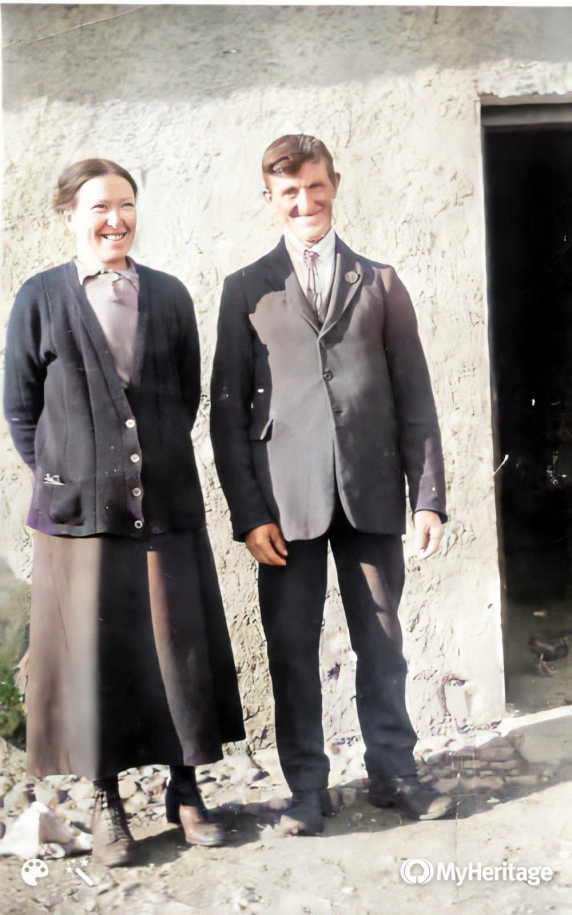
Margaret Mary Dufficy (McCormack)

Margaret Mary Dufficy (McCormack)

Born
21 Dec 1886
Died
17 Mar 1965
Gender
Female
Place of migration
Stayed in Ireland

Margaret Mary "Maggie" Dufficy was born on 21 Dec 1886 in house 5 in Lisduff, Ballygarden. She was the last of ten children born to Bridget Flanagan and Martin Dufficy, who died a few months before Maggie was born. 

She attended Clooncullane National School up until sixth class when she dropped out to help her mother manage their small farm. Her second cousins lived up the road from them and would likely have helped out. Her brother Thomas died in 1899 when she was just twelve. 

A match was arranged between her and a farmer of Carrowkeel- Thomas McCormack. They were married on 6 Mar 1916, witnessed by his cousin Jerome Kennedy and her sister Anne. They had six children during their marraige, Mary, Bridget, Kathleen, Margaret, John Joseph and Thomas. 

Maggie died on 17 Mar 1965, aged seventy nine. 

Associated communities

Clooncraff (Roscommon)

Our aim is to connect all people with a link to Clooncraff (Roscommon). You may live here, have visited here or maybe are tracing ancestors who left long ago. In any case, we’re sure to have lots to share and are delighted to welcome you.

Other ancestors in this community

Buildings in this community

No buildings are associated with this community.

Timeline events in this community

  • 1830s

    Clooncraff aka Clocraff or Cloonaff in the 1830s

    <p>A snapshot of pre-famine local history, as described in the "Topographical Dictionary of Ireland" by Samuel Lewis, 1837. (The information collected here was submitted by members of the local gentry and clergy of the time).</p>

    1 Jan 1837

  • 1850s

    Griffith's Valuation of Strokestown Union

    <p>The primary valuation of Ireland or Griffith's Valuation is a useful Census substitute for 19th-century Ireland. To confirm whether an ancestor could possibly be the individual listed, it is helpful to know the survey completion date for a parish (or the part of it that fell within the Poor Law Union surveyed).</p>

    28 Apr 1857

  • 1670s

    Elphin's Obelisk "Ailfinn" Falls

    <p>'Ailfinn' from which Elphin takes its name, refers to a large obelisk, which stood by a well here. It is recorded as having fallen down in 1675AD.</p>

    1 Jan 1675

  • 1740s

    The Census of Elphin Diocese

    <p>The Census of Elphin was organized by the Bishop Edward Synge in 1749 to establish the numbers of Protestants and Roman Catholics in his diocese (which embraced most of County Roscommon, part of south-east County Sligo and part of north-east County Galway). The information contained in this “census” is extraordinary for such an early date.</p>

    1 Jan 1749

Kiltrustan (Roscommon)

Our aim is to connect all people with a link to Kiltrustan (Roscommon). You may live here, have visited here or maybe are tracing ancestors who left long ago. In any case, we’re sure to have lots to share and are delighted to welcome you.

Other ancestors in this community

Buildings in this community

No buildings are associated with this community.

Timeline events in this community

  • 1830s

    Strokestown in the 1830s

    <p>A snapshot of pre-famine local history, as described in the "Topographical Dictionary of Ireland" by Samuel Lewis, 1837. (The information collected here was submitted by members of the local gentry and clergy of the time).</p>

    1 Jan 1837

  • 1850s

    Griffith's Valuation of Strokestown Union

    <p>The primary valuation of Ireland or Griffith's Valuation is a useful Census substitute for 19th-century Ireland. To confirm whether an ancestor could possibly be the individual listed, it is helpful to know the survey completion date for a parish (or the part of it that fell within the Poor Law Union surveyed).</p>

    28 Apr 1857

  • 1840s

    The Murder of Major Dennis Mahon 1847

    <p>The events leading up to Mahon’s death epitomized much of what was wrong with pre-famine Ireland: the largely parasitical landlord class, the deep sectarianism that further divided rulers and ruled, and an underclass largely dependent on the potato and living on the margin of subsistence.</p>

    2 Nov 1847