
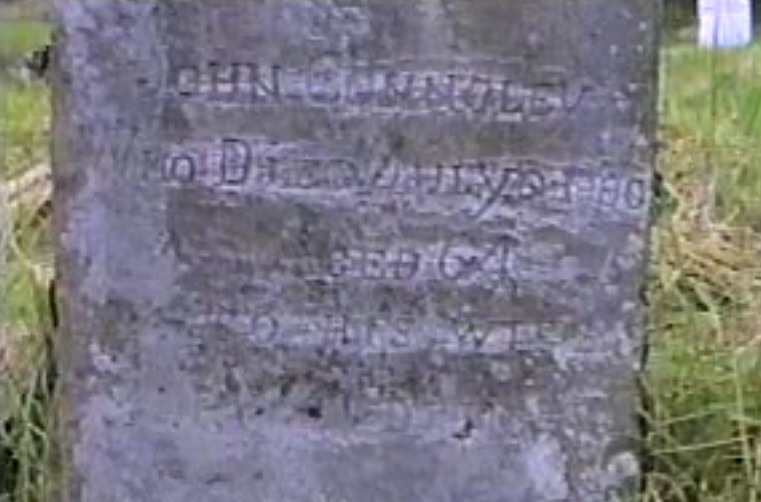
John Connolly
- Born
- 1816-01-01 12:00:00
- Died
- 1880-07-06 12:00:00
- Gender
- Male
John Connolly was born circa 1816 in Drumlea, Drumreilly (Upper) Conty Leitrim. His ancestors are unknown, but likely he was born on the farm leased by his ancestors as tenant farmers for possibly several generations.
A search of Griffith’s Primary Valuation of tenements positively identified the Connolly holding in Drumlea. Griffith’s Survey records that John Connolly occupied a House, Office (out-house) and land measuring 23 acres and 2 roods in the townland of Drumlea circa 1856. William Ormsby Gore was the immediate lessor or landlord and the holding had an annual ratable valuation of 8 pounds 10 shillings. John Connolly shared a further plot of land measuring 4 acres 1 rood and 26 perches with Francis Rorke and William Gill at plot 16 in Drumlea. Again, William Ormsby Gore was the immediate lessor of plot 16.
William Ormsby-Gore (14 March 1779 – 4 May 1860) the 2nd Baron Harlech, was a British Member of Parliament. Born into an Anglo-Irish family as William Gore, the eldest son of William Gore, M.P., of Woodford, County Leitrim, was the owner of the land.
Anglo-Irish (Irish: Angla-Éireannach) is a term which was more commonly used in the 19th and early 20th centuries to identify a social class in Ireland, whose members are mostly the descendants and successors of the English Protestant Ascendancy.[4]
The Protestant Ascendancy, known simply as the Ascendancy, was the political, economic, and social domination of Ireland between the 17th century and the early 20th century by a minority of landowners, Protestant clergy, and members of the professions, all members of the “Established Church” (Church of Ireland or the Church of England). The Ascendancy excluded from politics and the “elite” members of society, other groups, most numerous among them Roman Catholics but also members of the Presbyterian and other Protestant denominations, along with non-Christians such as Jews. Until the Reform Acts (1832–1928) even the majority of Irish Protestants were effectively excluded from the Ascendancy, being too poor to vote. In general, the privileges of the Ascendancy were resented by Irish Catholics, who made up the majority of the population.
The gradual dispossession of large holdings belonging to several hundred native Roman Catholic landowners in Ireland took place in various stages from the reigns of the Roman Catholic Queen Mary and her Protestant half-sister Elizabeth I and onwards. Various unsuccessful revolts against English rule caused much Irish land to be confiscated by the Crown, and then sold to people who were thought loyal, most of whom were English and Protestant. English soldiers and traders became the new ruling class, as its richer members were elevated to the Irish House of Lords and eventually controlled the Irish House of Commons. This class became collectively known as the Anglo-Irish.
And so, it was against this historical backdrop that John Connolly worked the fields of his leased farm, and lived in a simple thatched roofed home with his wife. John married Mary Cannon in approximately 1853. Mary, born in about 1833 was possibly the sister of John Cannon of Drumcoura, just a short distance down the road from their farm. Together they raised 10 children, five of whom, Briget (1854-1902), Mary (1859-1906), Bernard Francis (1861-1914), Margaret (1863-1906) and Annie (1869-1925) who would emigrate to New Haven, CT, USA. Annie would later return and marry Hugh Reilly who would also farm in Drumlea. Presumably, Patrick (1866 - ), Ellen(1867-1925), Rose Anna(1872-) and Jane “Jennie” (1878 - ) would remain in the area. Son James (1859-1919) would inherit the farm on John’s passing which occurred on July 6, 1880 of “cramps 6 hours.” His death was attended by his son, James.


