
Culture / Heritage · Tyrone
A detailed biography of John Dunlap was compiled by Dr Linde Lunney for The Dictionary of Irish Biography. It begins: “Dunlap, John (1746/7-1812), printer, was born in what is now Meetinghouse Street, Strabane, County Tyrone, a younger son among probably three sons and four daughters of John Dunlap, saddler, and Sarah Dunlap (née Ector). He may have been apprenticed to learn the printing trade in Gray's of Strabane; when he was about ten, he was sent to assist his uncle William Dunlap, who had earlier emigrated to America. William Dunlap had married Benjamin Franklin's niece, and was a printer and bookseller”.
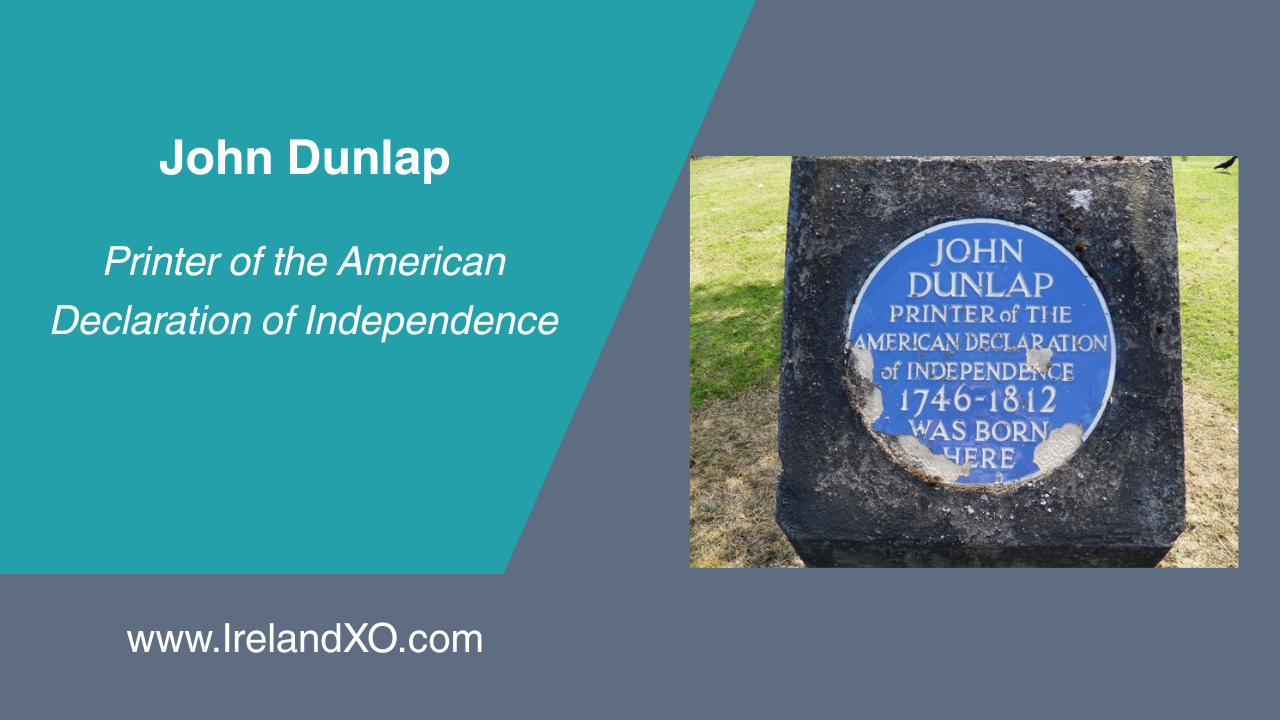
Meetinghouse Street, Strabane runs along the side of the River Mourne. The Presbyterian Meeting House used to back on to the river, but has long since gone; the congregation of 1st Strabane Presbyterian Church was founded about 1659. The house (No. 21) where John Dunlap, the printer, was born has also gone, but its location on Meetinghouse Street, is marked by a Blue Plaque, on concrete plinth, which reads:
JOHN
DUNLAP
Printer of The
American Declaration
of Independence
1746-1812
was born
here

The house (No. 21) where John Dunlap, the printer of the American Declaration of Independence, was born has gone, but its location on Meetinghouse Street, Strabane, County Tyrone, beside the River Mourne, is marked by a Blue Plaque. When he was about ten, John Dunlap was sent to assist his uncle William Dunlap, a printer and publisher in Philadelphia.
Alexander Ector Orr
It would appear that on his maternal side, Ector, John Dunlap was related to Alexander Ector Orr. Alexander Ector Orr, son of prominent Strabane merchant William E Orr who lived in a ‘fine, large commodious dwelling house’ in the Bowling Green, Strabane, was born on 2 March 1831. He was the first of the family to emigrate to the USA and settled in New York. Following his marriage to Juliet Buckingham Dows in 1856, he became a clerk at her family’s business, a freight brokerage company, then known as David Dows & Company. Based along Brooklyn’s East River waterfront, the Dows company was already the largest Eastern receiver of flour and grain routed from Chicago to New York.
As the company expanded, Orr became a partner, in 1861, and vice-president, leading the firm’s operational aspects. Dows’ silos and warehouses “held more than 3.5 million bushels of grain, making them the largest exporters of grain to European ports.” Alexander Ector Orr was also to become President of New York Rapid Transit Commission, playing an influential role in the building of the New York City Subway system.

Gray’s Printing Press is located behind an 18th-century shop front in the heart of Strabane, once the famous printing town of Ulster. It is here that John Dunlap, the printer of the American Declaration of Independence, is said to have learned his trade.
Gray's Printing Press
Gray’s Printing Press, 49 Main Street, Strabane, with a late Georgian shop-front, slightly curved, restored by the National Trust, ‘is a remarkable survival from an age when Strabane was an important publishing centre. Fifty books were published in the town between 1779 and 1840, and there were two newspapers, the Strabane Journal of 1771 and the Strabane News-letter of 1780. The interest of this particular shop, with its upper-floor print-works in the yard behind, lies in its connection with John Dunlap, the printer of the American Declaration of Independence, who is traditionally thought to have begun his trade as a boy at Gray’s Printery. In the print-works are a Columbian Press, an Albion Press, and three Platen Presses, all of the 19th century.’ Further detail here.
Gray’s Printing Press, a family-run business, printing books, pamphlets and newspapers, was first listed as a printing press in Strabane in the mid-18th century, and is the last one standing. With 12 printing presses in Strabane at this time, we don’t know exactly where John Dunlap obtained his apprenticeship. John Dunlap, however, took advantage of the opportunities that this network of printing presses created, gaining essential skills and an intricate knowledge of the printing process from an early age.
President Woodrow Wilson
Another Strabane native, James Wilson, grandfather of Woodrow Wilson, 28th President of the United States (1913-1921), is also reputed to have served his apprenticeship as a printer in Gray’s printing works at Strabane.
President Woodrow Wilson, after a policy of neutrality at the outbreak of World War I, led America into war in 1917 in order to "make the world safe for democracy." For his efforts in achieving world peace at the end of World War I, Woodrow Wilson was awarded, in 1919, the Nobel Peace Prize. He was the leading exponent of the League of Nations at the Paris Peace Conference of 1919.
The Wilson Ancestral Home still stands at Dergalt, 2 miles southeast of Strabane. The house contains some of the original furniture: a cupboard bed by the kitchen fire and curtained beds in the main bedroom. The first-floor room is a later addition. James Wilson lived in this white-washed thatched cottage until he left the port of Londonderry for Philadelphia in 1807 at the age of 20. James Wilson prospered and became editor of the Aurora, a leading Philadelphia newspaper.

The Wilson Ancestral Home still stands in the townland of Dergalt, Camus parish, 2 miles southeast of Strabane, County Tyrone.
James Wilson, grandfather of Woodrow Wilson, 28th President of the United States (1913-1921), lived in this white-washed thatched cottage until he left from the port of Derry for Philadelphia in 1807 at the age of 20.
John Dunlap in Philadelphia
In 1768 John Dunlap, who had now completed his apprenticeship, bought his uncle's printing and publishing business in Philadelphia. In November 1771 John Dunlap started a weekly newspaper, the Pennsylvania Packet; on 21 September 1784 it became the first newspaper of significance in America to be published daily. He was also the official printer to the Continental Congress which met in Philadelphia.
By July 1776, fighting between the American colonies and the British forces had been going on for nearly a year. The Continental Congress had been meeting since June, wrestling with the question of independence. Finally, late in the afternoon, on 4th July 1776, twelve of the thirteen colonies (except New York) reached agreement to declare the new states as a free and independent nation. That evening John Hancock ordered Philadelphia printer John Dunlap to print broadside copies of the agreed-upon declaration that was signed by him as President and Charles Thomson (of Maghera, County Derry) as Secretary.
John Dunlap is thought to have printed 200 Broadsides that July 4th evening which were distributed to the members of Congress. Today, there are only 25 of these broadsheets that are known to exist (23 in US and 2 in UK in National Archives, Kew, London). The original Declaration of Independence that was signed by John Hancock and Charles Thomson on 4 July 1776 is lost.
John Dunlap was also a member of the “Friendly Sons of St. Patrick”. In Philadelphia, merchants of Scots-Irish and Irish descent were founding members of ‘The Irish Club’ known today as the Society of the Friendly Sons & Daughters of St. Patrick. On St Patrick’s Day, 17 March 1771, they formed as ‘The Society of the Friendly Sons of St. Patrick for the Relief of Irish Emigrants’.
Members of the Irish Club, which included John Dunlap and Strabane-born merchant and shipowner, Thomas Barclay of Philadelphia, played a significant role in the American War of Independence (1775-1783), raising money for the revolution, establishing the Bank of Philadelphia, forming troops and volunteering for the Continental Army and the Pennsylvania Navy. They established their own personal medal, as an identifier, and in 1781 they adopted General Washington into the club.
John Dunlap was an American patriot; he was one of the founders in 1774 of the 1st Troop of Philadelphia City Cavalry, which became the body-guard of George Washington at Trenton and Princeton, saw active service as a cornet in the War of Independence in 1776–7; and in 1780 he subscribed £4,000 to found the National Bank for the United States to provide supplies for the new country's army.
John Dunlap retired in 1795 a very wealthy man; he had speculated in land, and owned 98,000 acres in several states. He married (4 February 1773) Elizabeth Ellison (née Hayes), a widow from Liverpool, and they had five daughters and three sons; two of the sons died in infancy. Dunlap died on 27 November 1812 and was buried with military honours in the graveyard of Christ Church, Philadelphia.