
Tipperary
Eugene Dunphy links a Young Irelander to a Tipperary mountain.

Every time I hear it, I’m taken back to my schooldays in Omagh, the steam rising from the gaberdine coats thawing out on the brass wall-hooks above the cast-iron radiator. ‘Now lads’, said the Christian Brother, ‘song time’, his cane tap-tapping out a waltz rhythm on the long wooden table. Standing behind our small lid-top desks, with heads held high and hands by our sides, he tapped out two counts of ‘ONE, two, three’, and on the second ‘three’ we sang as one, ‘Alone, all alone by the wave-washed strand ...’. The song in question is of course Slievenamon (‘Sliabh na bBan’), by Charles Joseph Kickham.
But what inspired him to write it? The answer lies in his family background and in his devotion to patriotic politics. The eldest of eight children, Charles J. Kickham was born on the 9th of May 1828, in Mullinahone, County Tipperary. His father John, who owned a drapery shop in the area, was well-known for his nationalistic fervour, and his mother Anne O’Mahony was a cousin of Fenian leader, John O’Mahony. Though rendered almost blind and deaf at the age of 13, the result of an accident with a hunting gun, young Charles immersed himself in study, and under pseudonyms such as ‘J’ and ‘Momonia’, contributed numerous poems and articles to the Celt, the Nation, the Irishman, and Shamrock.
On the 16th of July 1848, twenty-year-old Charles was one of approximately 50,000 people who gathered on the slopes of Slievenamon in Tipperary, to hear leading members of the Young Ireland movement deliver impassioned speeches on liberty and equality. During this ‘monster rally’, Thomas Francis Meagher unfurled a tri-coloured standard of green, white and orange, and declared to one and all that he wished to ‘decorate these hills with the flag of my country’. The significance of that day would stay with Kickham forever.

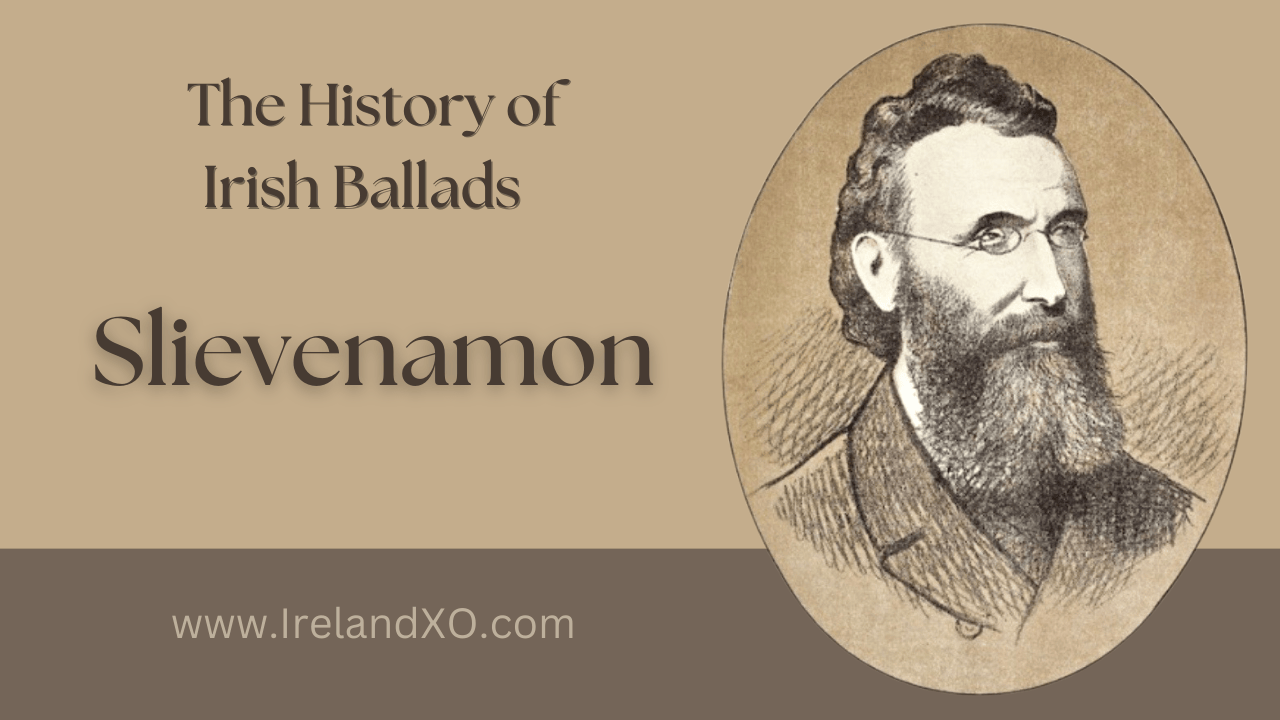
Charles J. Kickham (1828-1882)
Roused by the patriotic zeal of Thomas Davis, Kickham established in Mullinahone a branch of the Young Ireland Confederate Club, and at the end of July 1848 he participated in the failed ‘Famine Rebellion’, near Ballingarry, Tipperary. Becoming a member the Tenant Right League shortly after, he became dismayed at the lack of political progress within the League, and joined instead the more radicalised Irish Republican Brotherhood (IRB), better known as the Fenians.
In September 1859, the Celt – a journal issued by John O’Daly, 9 Angelsea Street, Dublin – published Kickham’s new three-verse poem, ‘Home Longings’, which would later be published as ‘The Maid of Slievenamon’, then ‘Slievenamon’. Memories of the rally of ’48 were clearly evoked in the final verse: ‘To see our flag unrolled and my true love to enfold’. Four years later, on a wet and windy day in August, the man from Mullinahone was back on the slopes of his beloved mountain to address a crowd of about seven hundred people, the Dublin Evening Mail recording that he called on ‘his brother nationalists to imitate the example of other oppressed peoples, and to woo the goddess of Freedom’.
Kickham subsequently joined the staff of the Irish People, a Fenian newspaper which had its headquarters in Parliament Street, Dublin, but when its offices were raided by police in September 1865, he was arrested, charged with treason, and sentenced to fourteen years penal servitude. Serving four years before being released from Woking Jail, he returned home to Mullinahone, his health in tatters, his spirit in tact.
He moved back to Dublin a short time later to continue his work with the IRB, and his first novel, Sally Cavanagh – completed while incarcerated in Woking – was published in 1869. In late 1878, when his friends noticed that he was in dire financial straits, they set up the Kickham Fund, the proceeds of which helped him pay for the basics while he applied himself to his passion, writing. A year later, James Duffy of Dublin published Knocknagow, Kickham’s acclaimed novel examining the fraught relationship between Irish tenants and landlords.
Charles J. Kickham died on the 22nd of August 1882, at the home of his friend James O’Connor, in Blackrock, Dublin. According to the Freeman’s Journal, ten thousand mourners attended his funeral at Mullinahone: he was later remembered as ‘the most loveable of men’ by W. B. Yeats. Reflecting on his life for The Advocate newspaper in July 1943, musician Josephine Patricia Smith remarked, ‘Even if Kickham had not written his famous novels Knocknagow, Sally Cavanagh and the rest; if he had not penned Slievenamon, he would have remained enshrined in the hearts of the Irish race’.
Adopted as an anthem by Tipperary hurlers, Slievenamon has been recorded by numerous singers, including Johnny McEvoy, Frank Patterson, Paddy Reilly, Louise Morrissey, and Daniel O’Donnell.
Alone, all alone, by the wave-washed strand,
All alone in the crowded hall.
The hall it is gay, and the waves they are grand.
But my heart is not here at all.
It flies far away, by night and by day,
To the times and the joys that are gone.
Ah, I never can forget the maiden I met,
In the valley near Slievenamon.
It was not the grace of her queenly air,
Nor her cheek of the rose’s glow.
Nor her soft black eyes, not her flowing hair,
Nor was it her lily-white brow.
Twas the soul of truth, and of melting ruth,
And the smile like a summer dawn.
That sold my heart away one mild May day,
In the valley near Slievenamon.
In the festive hall, by the star-watched shore,
My restless spirit cries.
My love, on, my love, shall I never see you more,
And my land, will you never uprise.
By night and by day, I ever, ever pray,
While lonely my life flows on.
To see our flag unrolled and my true love to enfold,
In the valley near Slievenamon.
Here is Eugene's video on this ballad: