
Culture / Heritage · Tipperary
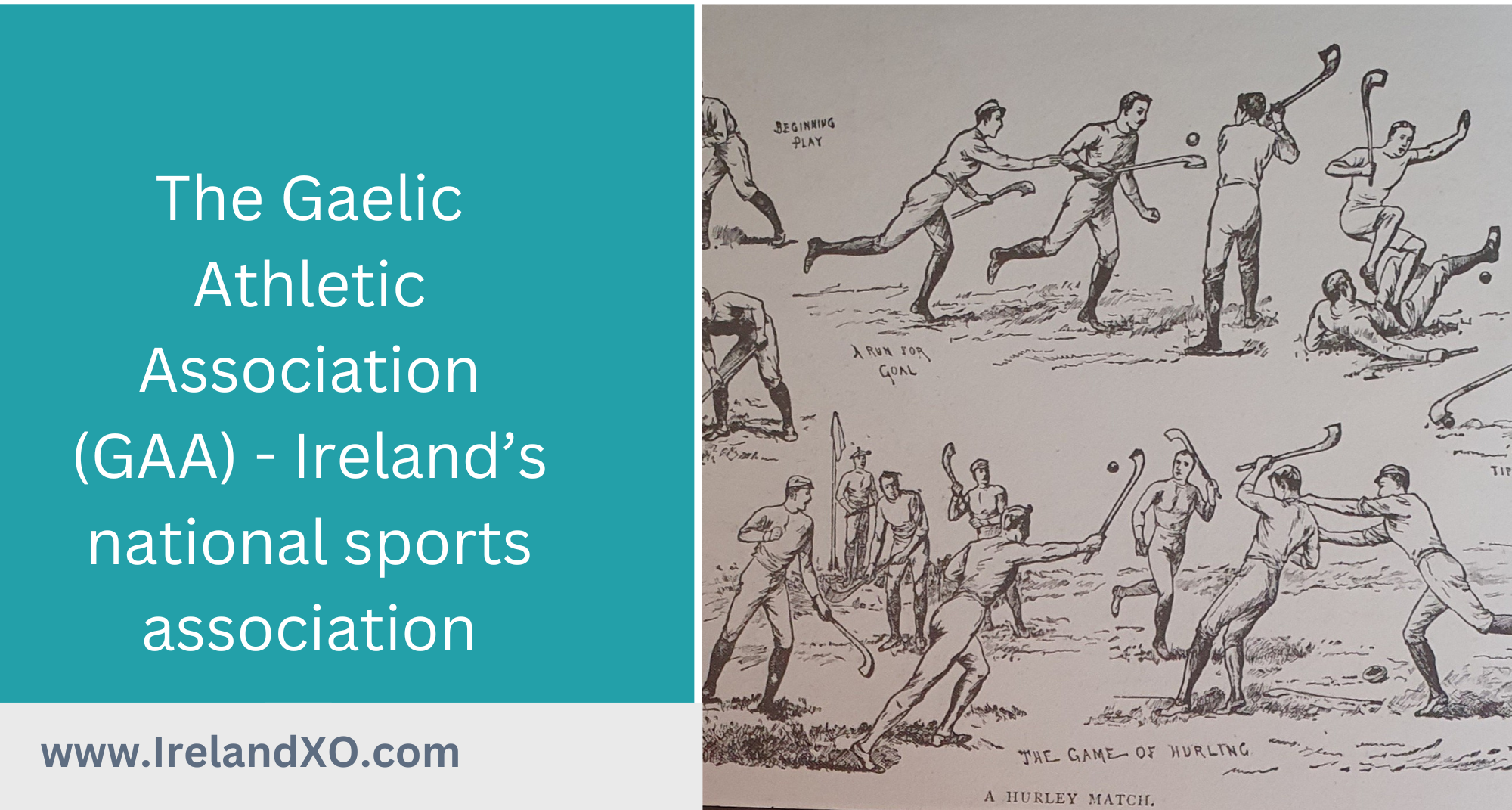
While today, the GAA sports include Hurling, Gaelic Football, Handball, athletics and Camogie (female), the original games have been recorded in the days of the Fianna and Finn Mac Cool in Irish mythology, with hurling being the dominant sport. Even in the Brehon Laws it was noted that 'The sons of kings and chieftains had their hurleys hooped with bronze or brass; compensation was granted for injuries , there was punishment for playing illegal men, and a substitute was allowed for a player who had to retire through injury'.
Founding of the Gaelic Athletic Association
The Gaelic Athletic Association (GAA) had been established in 1884 following a meeting in Thurles County Tipperary led by Michael Cusack and Maurice Davin. Both Cusack and Davin had a strong background in athletics and may have met through athletics championships, and it was through their common interest in devising a set of rules for athletics that rules for hurling and football were almost an afterthought. By football, they meant Gaelic football, a breakaway from the traditional British form of the game.
In a letter from Michael Cusack to Maurice Davin, dated 26 August 1884, where they discussed the setting up of the GAA and set a date for the first meeting, it was clear that Dublin was not a strong contender for support. He wrote:
‘Don’t bother your head about Dublin. The place couldn’t well be worse than it is. We’ll have to look to the provinces for men. Dublin will have to fall in or keep up the connection with England’.
According to Cronin, Duncan and Rouse , hurling had a more embedded Irish tradition linked with Cuchulainn and folklore of bravery. Strangely enough, Hurling was a popular game in Trinity College Dublin with the formation of the Irish Hurley Union in Trinity in 1879, and the establishment of the Dublin Hurling Club in 1882 whose matches were played in the Phoenix Park.
One of the founding rules of the GAA was that the dividing lines between Clubs were to be the boundaries of a parish. This connection between one parish and one club provided a loyalty to place and identity that ensured the widespread growth of the GAA.
It took a stronger hold in rural Ireland, mainly due to the fact that matches took place on Sundays, a day of rest for the farming community, as opposed to the ‘English’ games of soccer and athletics which prohibited Sunday play or meetings.
In the early All-Ireland finals the teams participating were clubs competing against each other and it was not till the early 1900s that clubs combined to form county teams. This helped boost support around the country to such an extent that the increased gate receipts led to sufficient funding for the GAA to purchase the Jones Road grounds which was later named Croke Park .
Such was the devotion to the GAA that over 80,000 attended Croke Park for an All-Ireland final, in the middle of the Emergency with travel and fuel restrictions .
Attending local parish/club matches was also a social outlet and many clubs extended their membership to non-playing members encouraged by social functions and dances, especially, celebrating club victories. This practice was noted by Cronin et al in their publication ‘The GAA, A People’s History’:
Michael Cusack, anxious that such activity would not revolve around drink, suggested that every club should have a room, away from a public house where members could go and read books and newspapers with a nationalist outlook.
Players
In general, the early GAA players were young Catholic men from lower middle classes. The predominant social background for players was mainly rural and farming but this was equally true for those joining urban clubs. As people moved from the rural areas to the towns for employment they brought their skills and love of GAA with them. They were also encouraged to join a club in their new home town which helped alleviate loneliness, the GAA being a common bond. In Dublin, the ‘Parish Rule’ was not strictly adhered to, and many clubs were forced to advertise for players to supplement clubs, a need which the rural ‘migrants’ gladly filled.
The GAA sports are still today considered amateur sports unlike Rugby or Football despite the high levels of skill and training required to compete.
The Association is not only predominant in Ireland but can now claim to be one of the largest sporting associations in the World.
A GAA Club can be found in every parish and every country where there are Irish Diaspora - from San Francisco to Singapore and everywhere in between.
Have you been to a GAA game? Next time you're in Ireland add it to your must-see list!
Sources:
Cronin, Mike; Duncan, Mark; Rouse, Paul The GAA, A People’s History (The Collins Press, Cork, 2009) .
Ó’Ceallacháin Séan The Dubs – Dublin GA since the 1940’s, (Gill & Macmillan, 2007)
Letter held in the GAA Museum - reproduced in Cronin, Mike; Duncan, Mark; Rouse, Paul The GAA, A People’s History (The Collins Press, Cork, 2009)
Read more
hurling fastest game in the world