
Meath
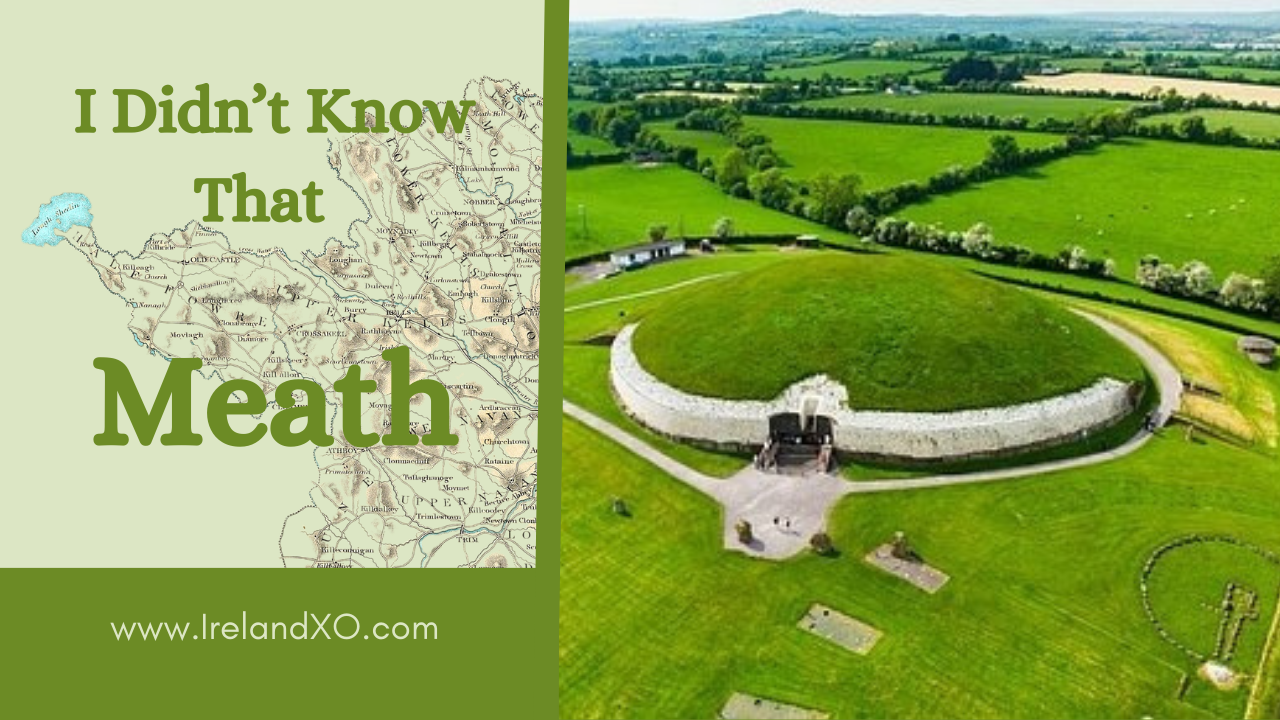
Newgrange was built in about 3,200BC., making it older than the pyramids of Egypt or Stonehenge in England. The most incredible feature of Newgrange is the roof-box above the entrance that illuminates the passage on the days surrounding the winter solstice. Close by are Knowth and Dowth, with their passage tombs and megalithic art, which are of similar antiquity.
At Loughcrew there are the remains of about 20 ancient tombs, which date from about 3,300 BC. It is one of the four main passage tomb cemeteries in Ireland. The tombs are spread across 4 hilltops, together called Sliabh na Caillí (mountain of the Cailleach [divine hag]). The light from the spring and autumn equinoxes illuminates the passage and the art on the backstone at Cairn T of Loughcrew.
The Hill of Tara was the Seat of the High Kings of Ireland until about the 11th century.
The Hill of Slane is where St. Patrick supposedly lit the first Paschal Fire in Ireland in about 433 AD. From then on he was allowed to preach the gospel in Ireland.
Trim Castle, which was completed in 1224, is the largest Anglo-Norman castle in Ireland. It was the Royal Mint until the 15th century. Henry of Lancaster (later Henry IV) was incarcerated there in 1399. In 1995, the castle featured in the movie Braveheart, starring Mel Gibson.
Slane Castle was the home of many rock concerts in the 1980s, featuring artists such as The Rolling Stones, U2, David Bowie and many others.
The Battle of the Boyne in 1690, between the armies of Catholic James II and Protestant William of Orange, is one of Ireland’s best-known battles. It led to the suppression of Catholicism in Ireland for many years.
Turlough O’Carolan (1637 to 1738), known as the last of the Irish Bards, was born at Nobber.
The well-known actor, Pierce Brosnan, was born at St. Mary’s Hospital in Drogheda. Although Drogheda in in County Louth, the hospital is in County Meath! The family lived in Navan.
The horse racing at Laytown beach, which take place once every year, are unique as they are the only beach races held under the Rules of Racing. The first recorded race at Laytown was in 1868.
Frances Beaufort (1774 to 1857), who developed the 13-point wind scale known as the Beaufort Scale, was born in Navan.
John Watson (1856 to 1908), of Bective, devised the rules for the game of Polo.
Ireland’s most famous book, The Book of Kells, was written at Kells in about 806 AD. It is now in Trinity Collage Library in Dublin.