
Kerry
Family Background
Maurice Talbot-Crosbie (1880-1953) was one of nine children of Lindsey and Anne Talbot-Crosbie of Ardfert Abbey, Co. Kerry with an estate of 10,000 acres. Regarding public life, the Crosbies or Talbot-Crosbies had at least two members elected to parliament in either Dublin or Westminster in each of the four centuries 1600-1900. While William Crosbie was elevated to become 1st Earl of Glandore in 1776, the 2nd Earl died without a male heir so the title became defunct. The Crosbie family roots trace to the MacCrossans, bards to the O’Moores and O’Connors of Laois and Offaly. The Talbot surname prefix arose from a marriage between a Talbot of Mount Talbot in Roscommon and an Ardfert Crosbie.
Maurice Talbot-Crosbie’s immediate ancestors held contrasting viewpoints on almost every major issue of the period. In contrast with his grandfather William, Maurice’s father Lindsey developed a fine reputation as a Home Rule supporter. He is best remembered for his key role in the Wyndham Act of 1903 which resulted in a major transfer of ownership of land from landlords to tenants.
 Ardfert Abbey (courtesy NLI)
Ardfert Abbey (courtesy NLI)
Maurice Talbot-Crosbie - Early Years
Early involvement in the Gaelic League is reflected in the image below showing Maurice Talbot-Crosbie holding a banner as Gaeilge in front of the Glandore Gate at Ardfert Abbey. However, family tradition led to him choose a military career.
 Maurice Talbot-Crosbie (right) and his brother Bligh, 1908
Maurice Talbot-Crosbie (right) and his brother Bligh, 1908

Maurice Talbot-Crosbie in later life (courtesy Vivienne Foley)
Early British Army career, surviving near tragedy
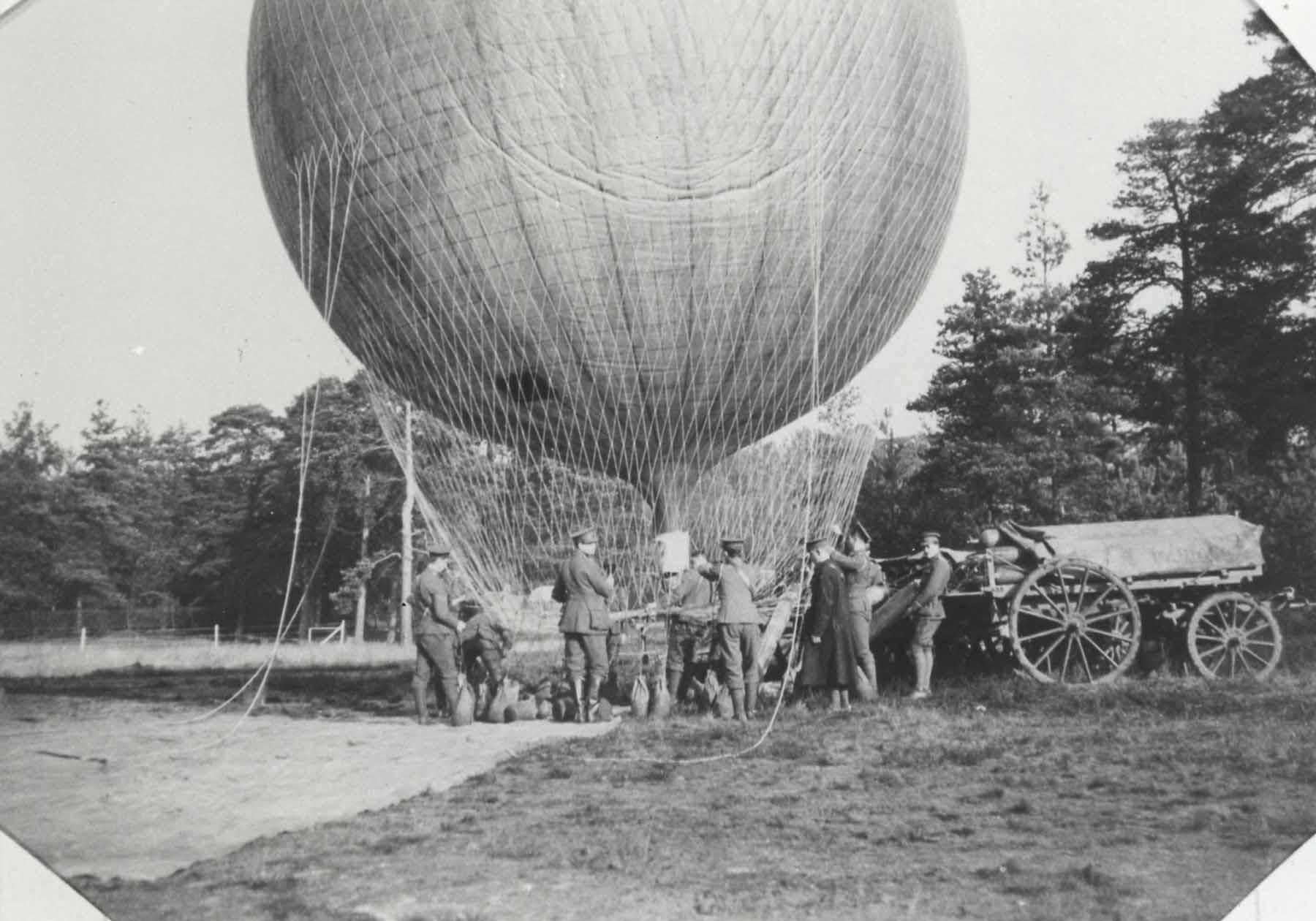
Maurice Talbot-Crosbie joined the British Army in 1903. He had an eventful early military career, twice narrowly avoiding death. His first escape occurred when, as Lieutenant Talbot-Crosbie, he was hit in the head by a stray bullet while on a rifle range in The Heath, Portlaoise. His first overseas posting was to India. He took a keen interest in flying, perhaps influenced by the exploits of his celebrated ancestor Richard Crosbie who became Ireland’s first aeronaut in 1795. While relocated to the British Army aviation base at Farnborough a second near tragedy followed as, having crashed in the sudden descent of a ‘war kite,’ he was rendered unconscious. He subsequently left the British Army in 1912 to pursue a business career in Cork.


Images of war-kites and balloons being used by the British Army pre-WWI
(both images courtesy Vivienne Foley)
Maurice Talbot-Crosbie in Cork, the Irish Volunteers
In Cork Talbot-Crosbie initially found employment with South Coast Defences, later becoming Chairman/Director of two businesses involving asphalt and a motor company. As a supporter of John Redmond, he was soon drawn into the political fray. Following the launch of the Ulster Volunteers followed by the rival Irish Volunteers, a Cork Corps of 6,000 men enlisted. While the Redmondites initially stayed aloof, there was later a coming together and Maurice Talbot-Crosbie became a member of the Cork Executive Committee.
On joining the Volunteers, he immediately came to play a senior role. As stated in Tomás Mac Curtain’s family memoir, ‘Capt. Maurice Talbot-Crosbie … was so experienced he was immediately elected commanding officer and exercised great influence on the men’. Talbot-Crosbie’s organisation of the Volunteers also extended into Kerry as evidenced by two images of him reviewing a very large assembly in Tralee.


(Courtesy Vivienne Foley)
The Commencement of WWI and the Split in the Irish Volunteers
World War 1 soon brought the powerful nations of Europe into conflict, creating fundamental differences among the Irish Volunteers. Led by Redmond the much larger faction including Talbot-Crosbie formed the National Volunteers. He played a central role in the split in the Cork Corps of the Volunteers.
The outbreak of World War I led to a crisis within the corps. At a key meeting … Talbot-Crosbie’s speech was received with prolonged cheering, with some of the Volunteers singing ‘for he’s a jolly good fellow’ … The overwhelming majority had rallied behind Talbot-Crosbie.
Thus Maurice Talbot-Crosbie, despite being originally from Co. Kerry, drew the great majority of the Cork Volunteers away from local leadership. Those Volunteers soon enlisted in the British army, with many sadly never to return from the front.
Maurice Talbot-Crosbie and World War I
When Maurice Talbot-Crosbie rejoined the British Army, he initially served with the 14th Light Division which was involved in some of the fiercest battles, including The Battle of Ypres and later The Battle of the Somme. While Talbot-Crosbie managed to survive, due to severe injury he was invalided. While living post-war initially in Devon he later returned to Cork.
The December 1918 Westminster Election.
The 1918 election extended the franchise from 700,000 in 1910 to almost two million. Nationally the election resulted in an overwhelming success for Sinn Fein, the party winning virtually every seat in the present Irish state.
While few from a Protestant landlord background chose to contest the election for a Nationalist party, Talbot-Crosbie became a candidate for the Irish Parliamentary Party for Cork City. The result showed that while Sinn Fein’s two candidates, both ex-colleagues on the Cork Volunteers executive committee, were comfortably elected, Talbot-Crosbie finished in third place of six. He then retired from public life and left to live firstly in England and later the USA.
Maurice Talbot-Crosbie, family life
Maurice Talbot-Crosbie married Olga Bevan of Kent in 1907 and they had two children, Viola born in 1908 and John in 1910. However, in 1920 Olga filed for divorce. Maurice then married an actress Kitty Wauchope in 1921. They soon left to pursue acting careers in Hollywood. By this time the Civil War was at its peak in Ireland resulting in the burning of Ardfert Abbey.

Maurice Talbot-Crosbie’s wife Olga with children John and Viola (Courtesy Vivienne Foley)
Maurice Talbot-Crosbie, Hollywood and later years
Having decided to enter the world of Hollywood make believe, Maurice introduced himself to the Los Angeles press as ‘Maurice Talbot Crosbie, Earl of Glandore’. He soon landed a role as Archduke Eugene in the film Merry-go-Round. While other minor roles followed, major success remained elusive. In addition to the film industry, Maurice was later featured in the press as an importer of rare dogs.
Maurice Talbot-Crosbie died in Hollywood in 1953 aged 72. From a Co. Kerry landlord background, he had been an Irish Volunteer supporting Home Rule, a Major in the British Army who was wounded in WWI and an actor in Hollywood. He was twice married and was father to two children. His was a life that had many remarkable twists and turns and certainly was never dull.
Note: A more detailed article including references is available, contact mjagkeane@gmail.com or download the PDF here.