
County Insights · Derry
A Story of Irish Wealth and Emigration
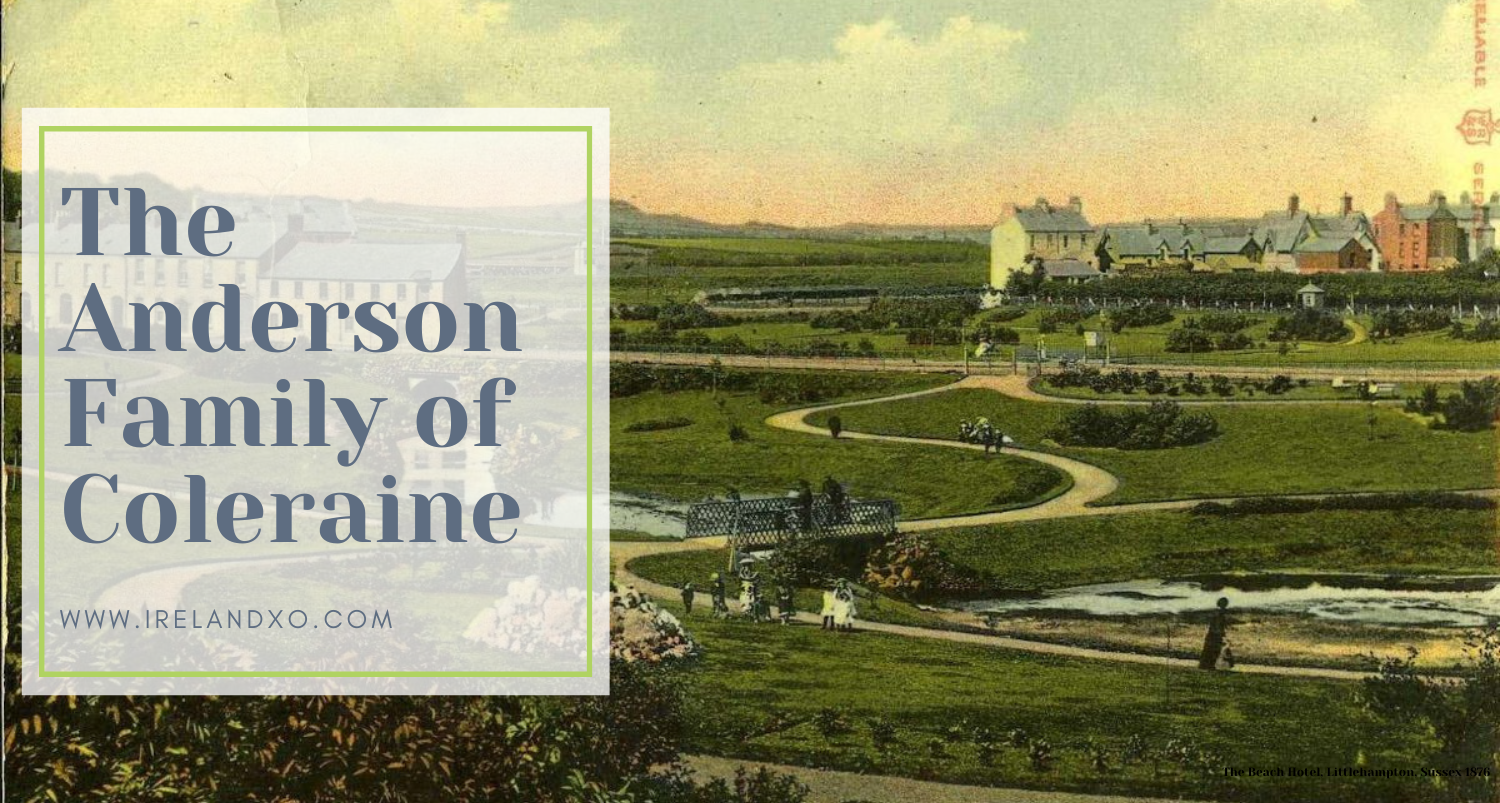
Walk through Anderson Park in Coleraine today and you are enjoying the legacy of Hugh Anderson, a wealthy spirit merchant who died in 1899 and left £3,000 to create a public garden for the people of the town. It was opened in 1904. Hugh is remembered as one of Coleraine’s wealthiest and most civic-minded men, but behind the fortune lies a wider family story of inheritance, emigration, and the enduring ties that bound relatives in Ulster to kin scattered across Canada and the United States.

Anderson Park. Courtesy of Coleraine Museum, Causeway Coast & Glens Borough Council.
The foundation of Hugh’s wealth was established by his uncle, Alexander Anderson, who was born in Bushmills in 1801: Alexander became a successful wine and spirit merchant of Church Street, Coleraine and by the time of his death at the age of 73 in 1871, he had amassed an estate worth almost £22,000. Alexander was buried in the family plot at the old graveyard at St Cuthbert’s church, Dunluce, County Antrim.

St Cuthbert’s old graveyard. Fiona Pegrum 2020
Alexander was one of nine children born to Alexander and Jane Anderson. His siblings were Jane, Esther (Thompson), Mary (Black), James, Betty (Glenn), Benjamin, John and Hugh. The last four emigrated. Betty was living in America at the time of her brother’s death, Hugh had departed in the mid-1840s and settled in New Brunswick, and Benjamin and John had set off for America in 1819, where they first settled in Pennsylvania before moving to Adams County, Ohio. From there, Benjamin’s family headed west to Indiana, while John’s children drifted south to Kentucky.

Findagrave.com SparkyErickson
Hugh Anderson, Alexander’s nephew, was born on 31 October 1842. He was the youngest child of eight, but when he was only three years old, his parents Hugh and Margaret, with all of his siblings, left Ireland for Canada, leaving Hugh behind to be reared by his uncle Alexander. His father died in 1854, and his mother and siblings would not return to live in Ireland .On his uncle’s death, Hugh, at the mere age of 28, inherited his uncle’s fortune, including the business premises. Hugh had the spirit licence transferred to himself and took on a business partner, John Stewart of Belfast, forming Anderson & Stewart, wine and spirit merchants. The firm prospered.
A Will of Wealth and Kinship
In 1872, Hugh embarked on a journey to America, determined to meet as many relatives as possible, to ‘renew his acquaintance with them, and add to the comfort of some of them’. He succeeded, and before setting off on another North American tour in 1876, he drew up his last will and testament, that reflected not only his wealth but his sense of family duty. His brother John in St. John, New Brunswick, and his sisters Jane Elsdon and Esther Anderson in Halifax, Nova Scotia and Roseanne Rose in Eastport, Maine, were each to receive £4,000. His aunt Elizabeth (Betty) Glenn of New Jersey and her children also benefitted.

The Derry and Antrim Year Book: Hugh Anderson
His cousins and friends living in Ireland and Scotland were to receive gifts. Hugh was also generous during his life, purchasing property for his niece Lizzie McIntosh (Jane’s daughter) and property for his sister Roseanne, and sending funds to the Canadian and American lines. In the late 1870s Hugh commissioned Belfast architects Young and McKenzie to design a mansion with sweeping reception rooms, eight bedrooms, a library, and all the conveniences of modern life on land leased from Sir H.H. Bruce in Coleraine’s Waterside. The house was named Tiev Tara.

Tiev Tara c.1914
From High Sheriff to Benefactor
Hugh lived there as a bachelor, immersing himself in Coleraine’s civic life. He served as Town Commissioner and was a key figure on the Harbour Board and the Bann navigation scheme. In 1893 he was appointed High Sheriff of County Londonderry, and he also sat on the Grand Jury. Banking and business interests widened his influence further. He was a keen horse rider and rower and was the original Director of the Coleraine Horse-Jumping and Recreation Club, as well as the Vice-President of the Bann Rowing Club. When Hugh died at Tiev Tara on 27 January 1899, aged 57, the Northern Constitution newspaper hailed him as Coleraine’s most prominent townsman.
His estate was valued at just under £40,000 and his will confirmed the breadth of his generosity. Alongside the family gifts and the £3,000 that created Anderson Park, he left funds for Presbyterian manses, £2,000 to aid Coleraine’s poor each winter, and smaller gifts for the needy in surrounding towns. Schools, orphanages, and hospitals benefitted, as did Coleraine Academical Institution, which gained not only £500 but also a scholarship in Hugh’s name. Long-serving employees and household staff received personal gifts but the distribution of wealth can create complications.
As executor and residual heir, John Stewart faced years of legal wrangling. Gossip and suspicion swirled, with some accusing him of self-interest. In letters to Hugh’s niece Lizzie, Stewart complained of lies and false assumptions, and admitted struggling to raise funds to meet the legacies. His wife Louisa was more forthright, insisting Hugh had every right to dispose of his money as he pleased. In one intriguing aside, she hinted that Hugh had fathered a son, who had been well educated and placed with a respectable family. The boy’s identity remains a mystery.
The business of Anderson & Stewart continued under the Stewart family until the 1930s, while Tiev Tara, which was inherited by the daughter of the Stewarts, was sold and eventually became part of Loreto College. Hugh Anderson and John and Louisa Stewart are buried together in Coleraine.
This is an abridged version of an article that was published in the Bann Disc 30.
_______________________________________________________________________
Learn more about your County Derry roots here or visit our message board to ask a volunteer a question here