
Cork
In the 18th and early 19th centuries, journeys across counties were challenging in Ireland, due to, among other things, a poor road network. At that time, John Anderson, a Scottish native who established himself in Cork and founded the town of Fermoy, won the tender to set up a road network and mail coach service across Ireland including between Dublin and Cork. This involved building new toll-roads, called turnpikes, and bridges.
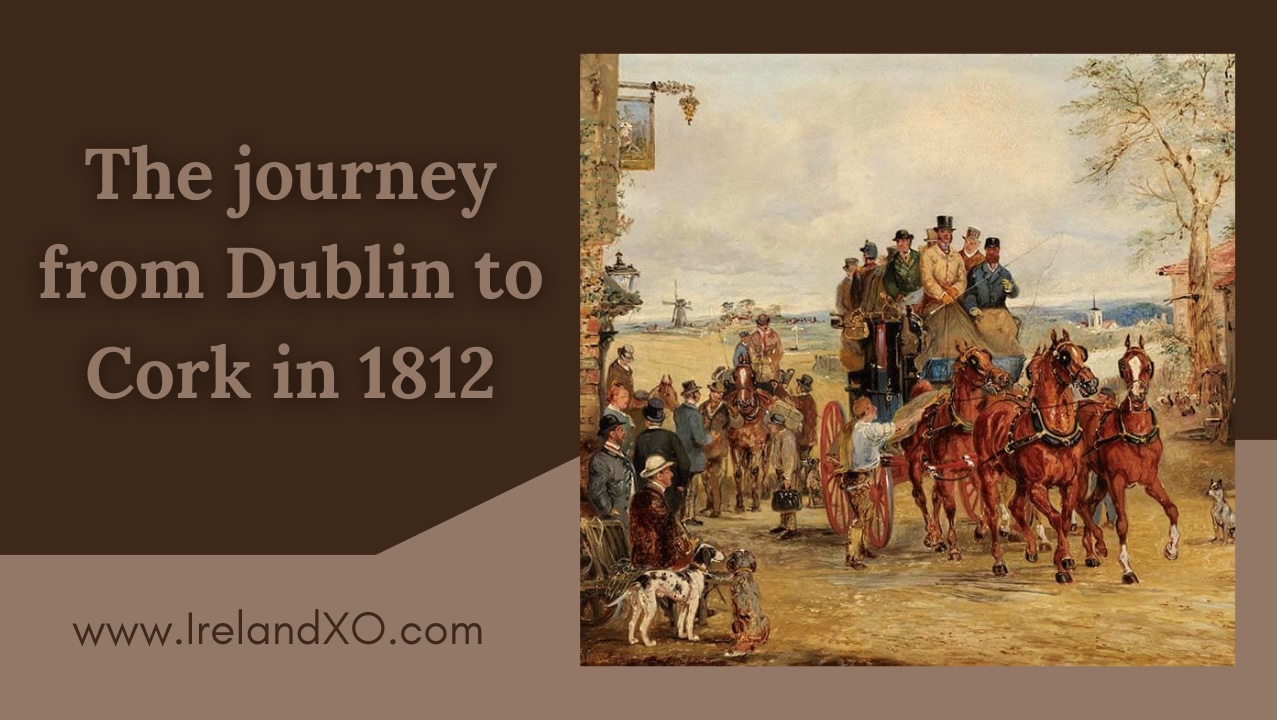
In addition to mail, the coaches also carried passengers, although the fares were expensive. The coaches were drawn by four horses and had two guards to protect the mail and passengers from highway robbers, such as Willie Brennan, the subject of the ballad Brennan on the Moor. The coaches travelled throughout the night and passengers slept inside the coach. There were stops along the route where they could change horses.
If your ancestors lived in Ireland in the early 19th century, it is unlikely that they travelled very far during their lifetime. Later in the 19th century, people with occupations such as stonemason, farrier or carpenter, would have travelled further. Their occupation would have added to the possibility of mobility.
Members of the British army moving from barracks to barracks also needed a mode of transport. This was the case with Samuel (Sam) Lister, who was born at Shibden Hall, Halifax, West Yorkshire, England. Sam, an officer in the 84th Regiment of Foot in the British Army, was assigned to duty in Fermoy, County Cork, Ireland in 1812. In his diary, Sam described his journey from Dublin to Fermoy. He described Fermoy as a neat little town situated on the river Blackwater and principally belonging to a Gentleman of the house of Anderson. Sam lived in Halifax, North Yorkshire and had to travel to Fermoy by land and sea, a journey that took 6 days (including a delayed sailing). The most detailed part of Sam’s journey is his description of the journey from Dublin to Fermoy.
We stopped at the mail coach hotel in Dawson street (on the 11th). Not one of the first inns but convenient as the coaches go from there to the different parts of Ireland. I left Dublin about 8 o’clock the same night which gave me little opportunity of seeing it (the city). I however saw a few of the streets. The outside of the parliament house, that was, which is very fine. But I should not forget to mention that on my passage I met with a Captain Macnamara of the 67th who cheated me out of a pound, not which he borrowed and forgot to pay. But perhaps it may be a good thing for me in the end as it will teach me to be more sparing of my money. This morning (12th) I found myself near Carlow after having travelled the whole night, but as it was very cold on the top of the coach, I remained in the inside till we came near Kilkenny - about which the country (is) pretty. I saw little of the city as the coach stopped at an inn in the outskirts of the town. I had however an opportunity of seeing the outside of an old castle belonging to Lord Ormond. From Kilkenny I passed through Callan in the country about which there are an immense number of old castles now all in ruins. From Callan the next place of any note was Clonmel which I understand is a fine old city, but merely passing through it was impossible to form an opinion of it. The most I remarked was the streets which were very narrow as they were also in Kilkenny. From Clonmel I saw nothing worth noticing till I arrived at Fermoy, excepting an old castle called Arfennum (Ardfinnan) which had its walls and tower still standing though in a very ruinous state. I arrived at Fermoy about 8 o’clock.
With a motorway between Dublin and Fermoy, the journey, through Carlow, Kilkenny, Callen, Clonmel and Ardfinnan, that took 24 hours in 1812 would take 2.5 hours in 2025, by-passing Portlaoise, Cashel, Cahir and Mitchelstown.
Thanks to Jan McGreal, Australia, for help with transcription of the diary. The transcription above is as the diary was written, except for a few editorial additions on grammar and a few additions in italics in brackets.