
Culture / Heritage · Cork
The Families Involved in the Great Muskerry Divorce
There were four closely connected families involved in the great Muskerry divorce of 1842, the Hawkes (Kilcrea House), the Penroses (Farran House), the Nettles (Nettleville, Carrigdrohid) and the Welsteads (Ballywalter House, near Fermoy).
The Hawkes Family
The Hawkes family were believed to have come from Worcestershire to Ireland with Cromwell’s model army. They settled originally in Bishopstown close to Ballincollig. They tended to have large families with repeated names. Over the generations they became substantial Cork landowners.
Samuel Hawkes and Sally Penrose married in 1805 and lived in Hawkesmount, Athnowen. They had 11 children, nine boys and two girls, Bridget and Sarah who was born in 1824, the year in which her mother died. Four of their sons, George, Samuel, John and Henry played a part in this story.
John Hawkes, who was the third oldest son, was 21 when he married Fanny Nettles of Nettleville, Carrigdrohid, aged 19, in 1829. A year later his father died at Hawkesmount. John Hawkes and his wife Fanny moved to Kilcrea House soon after their marriage and lived there for 11 years. During this time they had three sons.


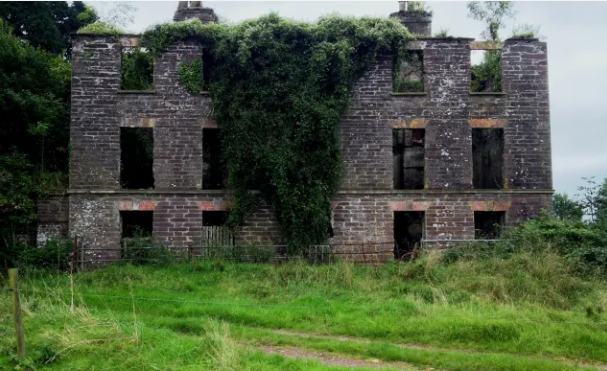
The Griffith map and the ruins of Kilcrea House
The Nettles Family
The Nettles family of Nettleville, Carrigdrohid, (see The Irish Aesthete, 2016) were neighbours and close family friends. John Nettles had come from Hereford and by 1666 had 2,258 acres in Counties Waterford and Cork. Nettleville was inherited by Richard Nevill-Nettles in 1828 and he was succeeded by Robert, who was Fanny’s brother. By the 1870s he had 1,684 acres.

The Nettleville Demesne, Griffiths map of 1852


Ruins of Nettleville
John Hawkes and Fanny Nettles, whose marriage was central to the affair, had probably known each other all their lives. Both were keen followers of the Muskerry hunt and would have attended many social gatherings. Both their fathers encouraged the relationship from the time Fanny was 16 years old.
Looking at photographs of the abandoned ruined building in an article about Kilcrea House (The Irish Aesthete, 2016) It is hard to imagine the dramas that occurred there over 160 years ago. In 1840 it appears that George Hawkes, the oldest brother and heir, was severely injured in a shooting accident and was taken to Kilcrea House where Fanny nursed him. Later documents show that George was blind, most likely as a result of a gun accidentally exploding in his face. He was cared for by other members of the Hawkes family until his death aged 92. Perhaps Samuel Penrose of Farran House also helped to care for George as it was alleged that he and Fanny became intimately involved at this time.
The Penrose Family
The Penrose family were originally a Quaker family from Cornwall who made their way to Muskerry via York, Wicklow and Waterford where the Penrose brothers set up Waterford crystal. They, very fortunately, sold out before the Act of Union, which crippled most of Irish industry. They then established themselves as merchants in Cork becoming very wealthy. Shandangan, Canovee and Farran House were their country homes. (I have not included images of Shandangan as most of the action took place at Farran).
There was an exceptionally close relationship between the Penroses and the Hawkes, with numerous marriages between the two families. Samuel Penrose born in 1804 (not to be confused with his double first cousin Samuel Devonshire Penrose born in 1816 of Farran Lodge) and John Hawkes born in 1808 were double first cousins. They lived a short walk from each other and had been like brothers from their childhood.


Farran at the time of the Griffith Valuation and today
Samuel Penrose married Sarah Welstead of Ballywalter near Fermoy in 1827. She was aged 21 and Samuel was 23. Their families were also closely related, making Samuel and Sarah double first cousins. In previous generations there were numerous marriages between the Penrose and Welstead families. Samuel and Sarah had one son also called Samuel Penrose born in 1828. He was aged 13 when his father eloped.
The Welstead Family
Thomas Welstead was granted 2,226 acres in Kerry and 1,726 acres near Fermoy in 1667. Sarah Welstead’s brother Richard had over 1,000 acres in 1870. When he died in 1896 he was succeeded by his nephew.

Ballywalter and Anne’s Grove on the banks of the River Awbeg near Fermoy
Common Social Background
Like many other wealthy Protestant landowning and merchant families who lived in this part of County Cork, they were all intricately intermarried. The Nettles and Hawkes families were close friends and keen supporters of the Muskerry Hunt. The older generation would have been involved in the judiciary as justices of the peace. Reading the records of vestry meetings of the Church of Ireland at Aghabollogue, we came to see the same landowning men meeting very regularly.
The Elopement - A Month of Bliss
In April of 1841 Fanny Hawkes of Kilcrea House told her husband John that she was going to visit her brother-in-law, Samuel Hawkes in Co Cavan. She was accompanied to Dublin by her younger brother-in-law, Henry Hawkes. They stayed at Morrisons Hotel, a highly fashionable location in Regency and Victorian Dublin, on the corner of what is now Number 1 Dawson Street. Fanny said she had a headache and went to bed early, suggesting that Henry might like to go to the theatre. On his return he found Fanny and her luggage were missing and learned that she had gone off with a gentleman. He wrote immediately to Fanny’s husband.
The report from the House of Lords divorce hearing states that Mr and Mrs Penrose had stayed, as man and wife, at The Beach Hotel, Littlehampton, for the month of May 1841. It is difficult to know what exactly they expected to happen next but it does not appear that they showed much foresight. Did they imagine that they could have a short interlude before returning unnoticed to their families? If they intended to live together as man and wife they could perhaps have gone to America. Two Hawkes brothers, Henry and Devonshire Penrose (my ancestor), had recently returned from Dexter, Michigan where they had lived for several years.

The Beach Hotel, Littlehampton, Sussex 1876
Littlehampton is a popular seaside town just over 20 miles west of Brighton on the south coast of England. The Beach Hotel was long established with access right onto the beach and advertised its very comfortable chairs. No doubt it had very comfortable beds too. It also provided accommodation for Samuel Penrose and Fanny Hawkes whose families paid for it both financially, socially and emotionally.
The Criminal Conversation Case and Newspaper Reports
News of the criminal conversation case taken by John Hawkes was widely reported at home and abroad (e.g Bristol Mercury, April 1842). A report in the Cork Chronicle dated March 1841 outlines the action taken by John Hawkes against Samuel Penrose for criminal conversation claiming £10,000 damages for trespass and seduction. (£10,000 is equivalent to just over £1,000,000 in 2022). The case was tried in Cork before Justice Thomas Lefroy. The jury reduced this to £2,000 (£230,615 in 2022), as it claimed that John Hawkes had been warned about Fanny’s misconduct. She had deliberately lied when she sent her brother-in-law to the theatre on the night of the elopement. ‘Her loss could not be too great to her husband as her character was not irreproachable’.
Samuel Penrose did not defend himself, and ultimately paid damages of £2,000. He admitted guilt, ‘an act of unhappy indiscretion’, when he yielded to temptation. However, Judge Lefroy pointed out to the jury that ‘the plaintiff was in some measure necessary to his own misfortune’. It was alleged that John Hawkes had been aware of rumours. The defendant’s council alleged that the defendant ‘was more the seduced than the seducer’. Damages had already been paid by the time the petition for a divorce had reached the House of Lords the following year.
The Divorce in 1842
Divorce was not legal in the United Kingdom until 1858. Before this, under criminal conversation, the husband of an adulterous wife could claim damages from his wife’s lover. The House of Lords ordered that transcripts of a preliminary trial for criminal conversation should accompany every divorce bill brought before it. In order to remarry, a full Act of Parliament was required. Only 300 Divorce Acts were granted by the House of Lords prior to 1858, approximately 10 cases per year, and these were only possible for very rich men. (This contrasts with today where there were 103,592 divorces granted in the UK In 2022. Even in Ireland there were 73,208 divorced people in 2017). In the case of the Hawkes divorce, as previously discussed the preliminary trial was held in Cork. This makes the Hawkes v Penrose case both unusual and locally sensational, as reflected in reports in the Cork Chronicle at the time.
The bill for the Hawkes Divorce by Act of Parliament was brought before the House of Lords on 10th June 1842.
After the Great Divorce
It does not appear that John Hawkes remarried. Perhaps he drowned his troubles in the hunting field as he became Master of the Muskerry Hunt. According to Bramley he died of heart disease aged 64 at Ardnalee, Monkstown village south of Cork city in 1872.
It also does not appear that Fanny remarried. She is recorded as living at 97 Great Georges Street but this could be either London or Dublin. This photo taken late in life shows a confident well-dressed woman, with her books and spectacles. She looks very vigorous and healthy. She outlived her former husband and died in 1875 ‘as a widow’ aged 65 at Number 5, Morrisons Quay, Cork city. She had been ill for four years and Mary Reardon from Kilcrea was with her when she died.

Samuel Penrose died unmarried in March 1869 aged 65. He left very little in his will which was administrated by his grandson, Frederick Hutchinson Warren of Shandangan, Canovee.
Sarah Welstead Penrose’s position as the deserted wife must have been very difficult. It is most likely that she returned to her family home at Ballywalter. She re-married Hugh Lawton of Castle Jane, Glanmire Co. Cork and had two more children, Hugh Lawton and Sarah Anne Welstead Lawton. She died in 1850.
What Happened to the Four Children?
Samuel Welstead-Penrose b 1831 was 10 years old in 1841 when his father eloped with Fanny. He graduated from Hertford College, Oxford in 1855 and was ordained as a Church of Ireland clergyman. He married Mary O’Callaghan in 1858, had four sons and died in Kinsale in 1918 aged 90. He succeeded his uncle as owner of Ballywalter in 1890.
Samuel Hawkes was born in 1831 at Kilcrea and was only 10 years old when his mother eloped with Samuel Penrose of Farran House. He joined 37th Foot of the British army in 1856 and then served in India where he was promoted to the rank of Captain. He married Bessie Norris and lived in Templemartin, a short distance south of Kilcrea. Sam and Bessie had three children, born 1865, 1866 and 1867. Sam died in Plymouth in 1868. Bessie remarried Captain Albert Charles Pickering in Kilcrea in 1872 and they migrated to Queensland Australia. They had 2 sons Charles b. 1873 and Richard b 1893. Bessie is buried in Brisbane.
Richard Neville Nettles Hawkes b 1833 was seven years old when Fanny eloped. Sometime between 1864 and 1868 he joined the Australian gold rush which peaked between 1851 -1860s. He settled first in Maldon, Victoria, Australia. In 1868, aged 35, he was married to Jean Black who was born in Scotland. They had seven children in Maldon before moving to the goldfields of New Zealand where they had 6 more children. He died in Dunedin in 1900. It is likely the photo of Fanny was taken for her family in Australia and New Zealand.
John Devonshire Hawkes b 1836 was six when Fanny eloped. He married Elizabeth Eliza Taylor of Kerry and lived at Rosemount, Currahaly, Farran. They had nine children. He inherited Kilcrea and by 1870s held over 2,000 acres.

Rosemount, now the home of Dr Paddy and Geraldine Crowley
John, Richard and Samuel Hawkes are listed as the owners of land for sale in the Encumbered Estates of 1864.
Judge Lefroy and Mr Darcy in Jane Austen's Pride and Prejudice
Judge Thomas Lefroy, who presided at the trial of Samuel Penrose for criminal conversation, has been long associated with the character of Mr Darcy in Jane Austen’s novel Pride and Prejudice (1813). A recent article featuring the story in The Guardian newspaper (September 2022) included portraits of both Jane Austen and Tom Lefroy and recounted some of the contents of Jane’s oldest surviving letter. In the letter, which was being shown in an exhibition in public for the first time, Jane confides to her sister Cassandra of ‘flirting her last with a dashing Irish lawyer’ (Tom Lefroy) and, as recounted in The Guardian, the relationship ‘is believed to have inspired one of her most famous characters, Mr Darcy’. At the time Jane Austen is described as a fun-loving 20-year-old about to write the story that became Pride and Prejudice. In addition to the letter, the new exhibition, titled ‘Jane Austen in Love’, featured a portrait of Lefroy at Jane Austen’s former home in Chawton, Hampshire.
There are also notable similarities between the storyline in Jane Austen’s Mansfield Park (1814) and the later Penrose-Hawkes trial of 1841. The novel featured four families of similar background along with an elopement and divorce. Given their earlier romantic relationship, it is most likely the Judge Lefroy would have read Mansfield Park and one may wonder if Jane Austen’s character assessments in the novel might have influenced Lefroy’s judgement in the later divorce case.
Limerick born Thomas Lefroy went to London to study law and sometimes stayed at his wealthy uncle’s home where the family were friends and neighbours of the Austens. However, Lefroy was the eldest of a large and fairly impoverished Limerick family and was obliged to return to Ireland to help provide for his younger siblings. He rose through the ranks to become MP for Dublin University 1830–1841, Privy Councillor of Ireland 1835–1869 and Lord Chief Justice of Ireland 1852–1866.
Sources
- Fennel Cecily; Ancestry research, 2015
- Bramley Sue; NZ Hawkes family history
- Lavelle Susan; The Pearsons of Mount Cross
- Find My Past, various issues
- The Irish Aesthete, 2016
- Bristol Mercury
- Cork Chronicle
- Austen Jane; Pride and Prejudice 1813 and Mansfield Park, 1814