
Culture / Heritage · IrelandXO
The Origins of the ITA
The Irish Tourist Association, established in 1925 under the aegis of the Minister for Industry and Commerce, was Ireland’s first national tourism body. Its primary aim was to promote tourism for the nation's economic benefit. Despite initial funding challenges, the ITA succeeded in advocating for government support, culminating in the Tourist Traffic Act of 1939. This act enabled the ITA to receive state grants, allowing it to open local tourist offices and embark on initiatives such as the county surveys of the early 1940s.
These surveys, conducted predominantly in 1943 and 1944, marked a pioneering effort to catalog Ireland’s cultural, historical, and natural assets, laying the groundwork for modern tourism organizations like Bord Fáilte (now Fáilte Ireland).
The ITA Survey: A Window into 1940s Ireland
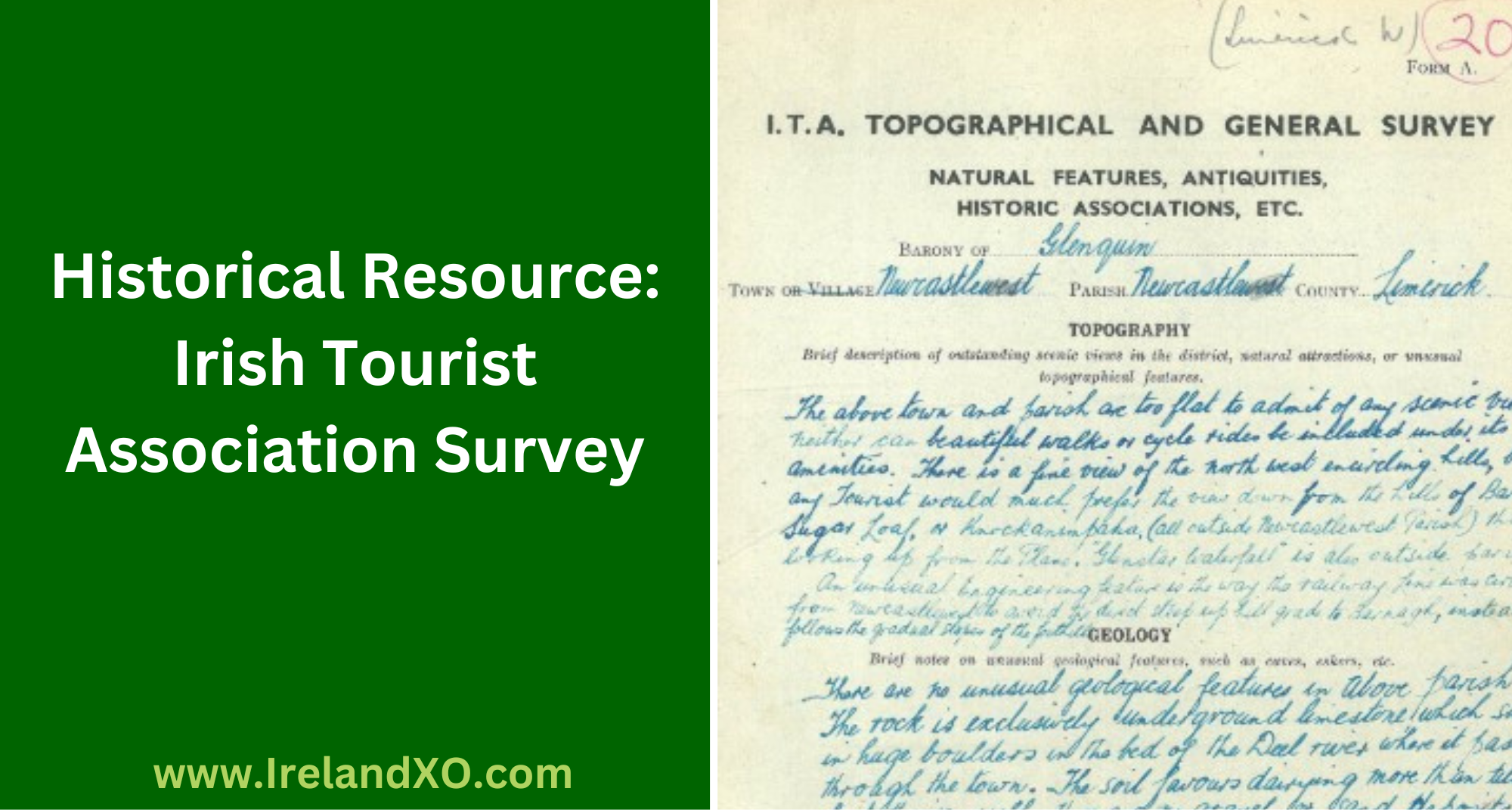
The ITA’s Topographical and General Survey documented the cultural and physical landscape of Irish counties through five detailed forms, supplemented with additional materials such as drawings, photographs, and site notes. The categories covered were:
• Natural Features and Antiquities (Form A): Including topography, geology, castles, burial places, curiosities, and historical associations.
• Sports and Games (Form B): Covering angling, hunting, athletics, and annual events.
• Holiday Amenities (Forms C & D): Providing details on public services, cultural societies, schools, fairs, transportation, and other local resources.
• Accommodation (Form E): Listing hotels, guesthouses, and boarding facilities.
These forms offer a comprehensive view of community life, infrastructure, and local traditions. From descriptions of monasteries and archaeological sites to notes on fairs and petrol stations, the survey captures a slice of Irish life in the 1940s.
Unique Features and Challenges
Each survey response was handwritten, often accompanied by supplementary materials such as architectural sketches, reproductions of memorial plaques, and photographs of notable landmarks. While many of these elements have survived, others, including photographs of certain areas, have been lost over time.
For researchers and genealogists, the survey serves as a valuable resource. A report on County Wicklow, for example, highlighted the county’s unrecognized beauty but also noted the lack of accommodation in its western regions. Importantly, the survey reflects the generosity and cooperation of local communities who contributed their knowledge and time.
A Tool for Discovery
The ITA Survey is particularly useful for those seeking to understand the day-to-day life of mid-20th century Ireland, from its sporting clubs and guesthouses to its graveyards and village fairs. For members of the Irish diaspora, it offers a connection to the places their ancestors once called home.
Accessing the Surveys
Although a unified database does not yet exist, the surveys are available through county library services, with some libraries digitizing their collections for online access. Those interested in exploring their heritage or the history of specific Irish regions should contact the relevant county library to discover whether the records for their area of interest have been preserved and digitized.
Conclusion
The digitization of the Irish Tourist Association Survey has opened a window into a richly detailed account of 1940s Ireland. As a repository of cultural, historical, and geographical information, it stands as a testament to Ireland’s vibrant local histories and a valuable resource for research and heritage exploration. While challenges remain in terms of accessibility and completeness, this archive is a significant step toward preserving and celebrating Ireland’s storied past.