Penny,
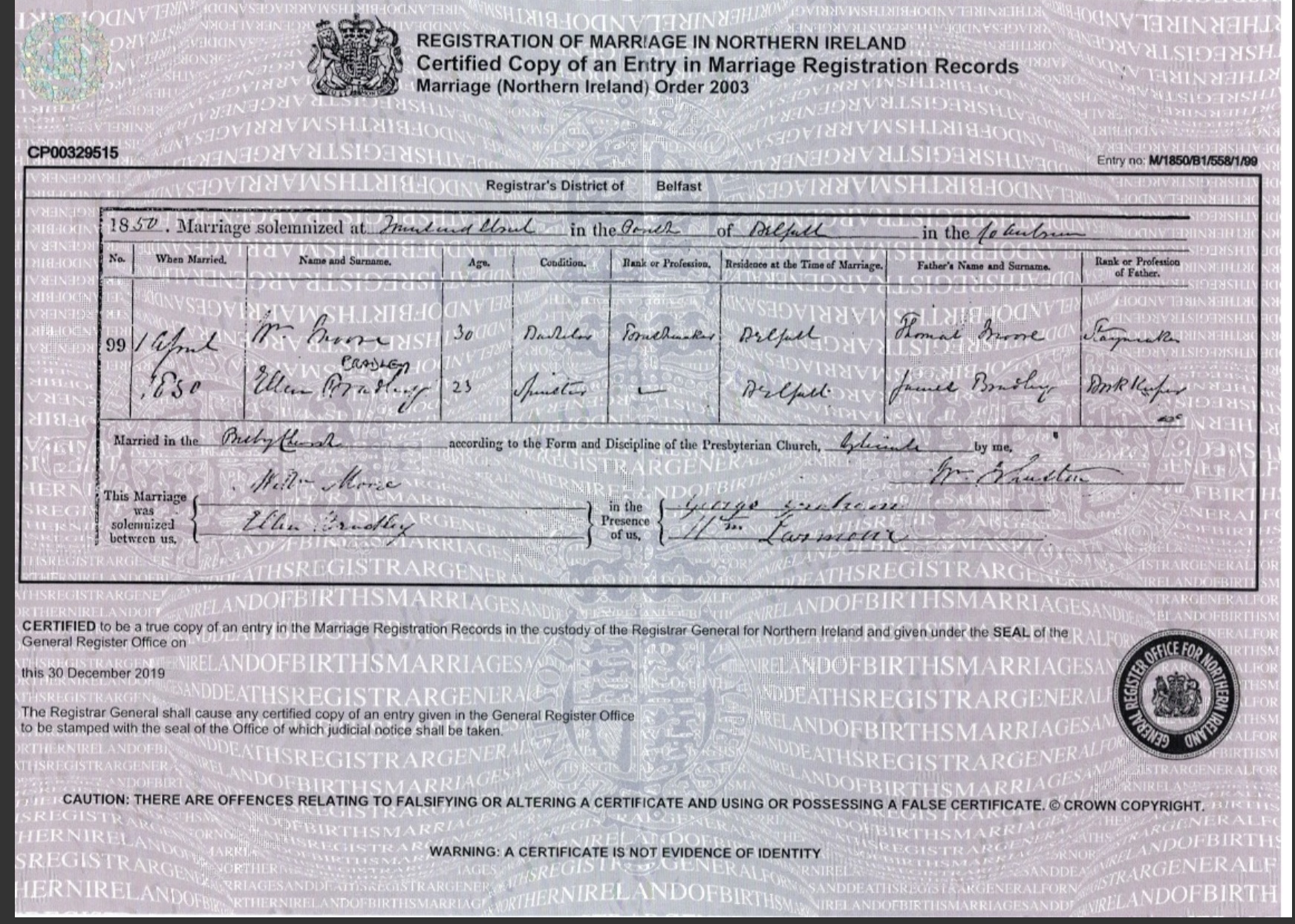
The various attachments aren’t in a format that allows them to be opened. However here is a link to the marriage:
https://civilrecords.irishgenealogy.ie/churchrecords/images/marriage_returns/marriages_1850/09384/5398796.pdf
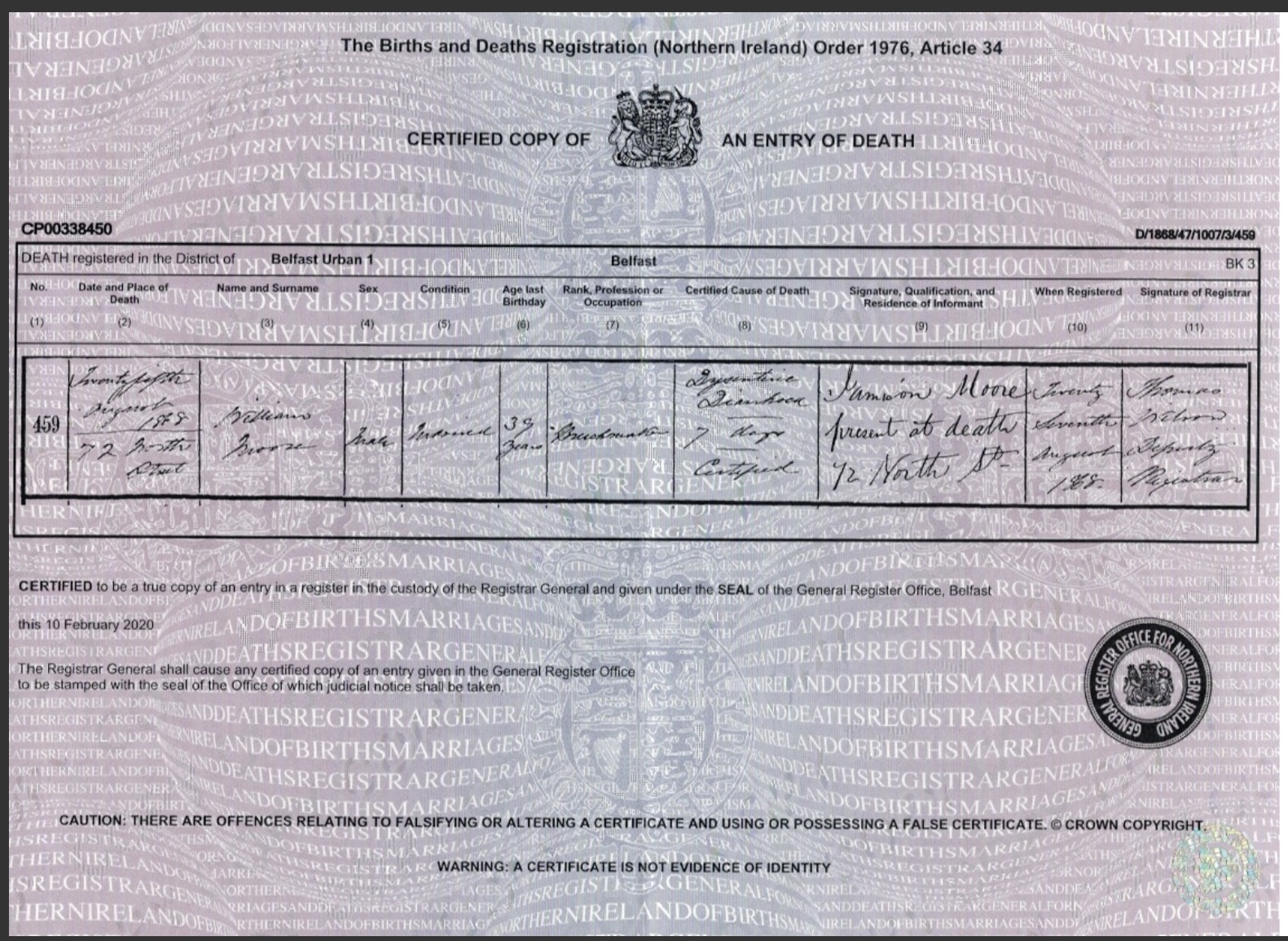
Ages on death certificates were often just guesses. In the 1800s people in Ireland rarely celebrated birthdays and often didn’t know quite how old they were. If officialdom asked for an age, it was common to just guess, especially with a death where the informant might have even less knowledge. A discrepancy of 9 years is not unusual.
In general Australia was a much less popular destination for Irish emigrants, simply because of the cost of getting there. So those who did go there were either assisted in some way (ie by the state or by relatives) or comparatively well off.
Here’s William’s probate abstract. His estate is described as “under £300.” (Using an inflation calculator, that appears to be around £43,000 today).
| |
|
The Will of William Moore late of North-street Belfast County Antrim Hardware Merchant deceased who died 25 August 1868 at Belfast aforesaid was proved at Belfast by the oath of Ellen Moore of North-street Belfast aforesaid the Widow and sole Executrix.
The will itself is on-line and mentions him owning property in Arkwright St. At least 8 houses, plus a piece of empty ground suitable for building on, so he wasn’t too badly off. He left his shop to his son Jameson, upon reaching 25 years of age. Possibly the son chose to sell it in 1874?
I think you may struggle to find much about William Moore’s origins. It’s important to know that a lot of Irish baptism records are not on-line, especially for Presbyterian families, and therefore it can be hard going researching them. If he was Presbyterian and born in Belfast then most of the church records are in PRONI but you need to go in person to search them. For the 1820s there are probably about 10 Presbyterian churches in Belfast that were open then.
But we don’t actually know he was born in Belfast. The population of Belfast expanded dramatically in the 1800s. In it’s early years it was largely Presbyterian (being dominated by Scots who had moved to Ireland in the 1600s). The population of Belfast in 1800 was about 20,000. In 1901 it was 349,000. The establishment of the shipyards, 50 linen mills and countless support industries led to a huge influx of workers from the surrounding countryside who were looking for better paid jobs in the city.
Your ancestor might have been born in Belfast but it’s equally possible that his parents were amongst the tens of thousands who were pouring into the city every year around that time. And without some idea of where they came from, it’s a needle in a haystack.
Possibly DNA testing may be a way of matching with others who have additional information about where the family originate. Family Tree DNA reportedly has more people with Ulster roots than any other company. That obviously increases the chances of finding a match. You might want to try them or, if you have already tested, you can transfer your results to them for no fee.
The North of Ireland Family History Society is running an Ulster DNA project in conjunction with FTDNA and can offer testing kits at a reduced price. http://www.nifhs.org (Go to DNA project on the website).
|