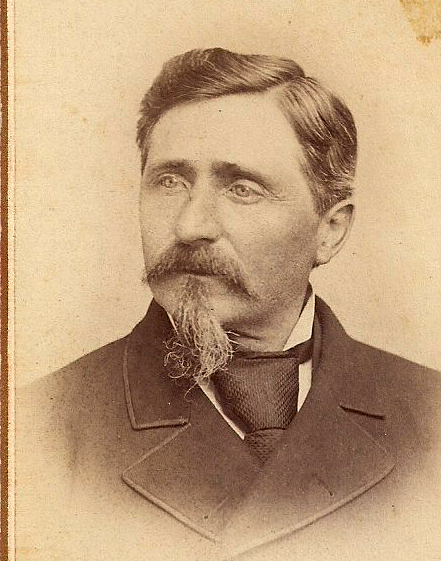
William Moylan
- Born
- 1819-01-01 12:00:00
- Died
- 1874-01-14 12:00:00
- Gender
- Male
William Moylan was baptized in the Parish of Tipperary, Diocese of Cashel and Emly, County Tipperary, Ireland on 25 May 1819. He was one of six known children born of David and Mary (Guinan) Moylan. The six children, each of whom were baptized in the Parish of Tipperary, Diocese of Cashel and Emly, County Tipperary, are (in chronological order):
John Moylan - 21 November 1815
Peter Moylan - 16 December 1816
William Moylan - 25 May 1819 (my GG Grandfather)
David Moylan - 23 February 1825
Mary Moylan - 22 October 1827
Honora Moylan - 6 October 1830
There likely was a seventh child by the name of Julia Moylan, however, her baptismal record has not been discovered at the time of this writing.
Though no parish record has been discovered that documents the marriage of William Moylan, it is known that he married Margaret Quirk(e) presumably in County Tipperary. The marriage likely took place in the 1835-1837 timeframe. The marriage of William Moylan and Margaret (Quirk(e) Moylan produced five children. Parish records from the Parish of Toomevara, Diocese of Killaloe, County Tipperary have been discovered that document four of the five children's baptisms. These parish records indicate that the family was living in Barnane at the time of all of the children's baptism. The children from this marriage (in baptismal order) are:
Patrick Moylan - 12 February 1838
Mary Moylan - 21 January 1841
John Moylan - 30 September 1844
Judith Moylan - 24 November 1845
A fifth child known to have been born to this family was named Edward Moylan. Family celebrations of his birthday were observed on 22 August with the birth year traditionally recognized as 1839. This would fit in chronologically with the known baptismal dates of his siblings.
Sometime in 1847, William Moylan left his family behind in County Tipperary and made his way to America with the hope of establishing himself and earning sufficient money to ultimately have his family join him. For approximately two years he worked in the New York area before moving west to the state of Iowa. In 1846 Iowa became a State and by 1848 the government was aggressively making prime farmland available at very reasonable prices to those who had an interest in settling the Midwest US by farming. William took advantage of that opportunity in 1849 and by1850 had saved enough money to summon his family to join him in Iowa on the acreage that he had recently acquired near the town of Atalissa in Muscatine County, Iowa.
In October 1850, William's family left Ireland on the ship "Forest King" for the Port of New Orleans in America. His recently acquired land would be more easily accessible by arriving at New Orleans and then sailing by riverboat up the Mississippi River to their new home in Iowa. Sadly, William and Margaret's youngest daughter Judith had passed away sometime between William's departure from Ireland and the rest of the family's departure for America. The four remaining members of the family successfully made the journey and arrived at the Port of New Orleans on 18 October 1850. However, during the course of the voyage to New Orleans, the two youngest remaining children (Mary and John) contracted cholera and died during the riverboat portion of the trip from New Orleans to Iowa. They were buried at an unknown location somewhere in the State of Illinois. The two oldest sons, Patrick and Edward survived the trip and with their mother were greeted by William and began their new life in America.
William continued to improve his land and farm it until his death on 14 January 1862. He was buried at St. Joseph's Cemetery in Cedar valley, Iowa. His wife Margaret lived with her oldest son Patrick's family on the farm until her death on 17 May 1874. She was buried next to William at St. Joseph's Cemetery in Cedar Valley. Their son Edward (my G Grandfather) died in Iowa City, Iowa on 16 January 1922 and the oldest son Patrick died on 20 October 1923 in Wilton, Iowa.