
Tristram Moore
- Born
- 1 Jan 1767
- Died
- 1 May 1839
- Gender
- Male
My 5 x great grandfather Tristram Moore arrived in the Colony of Sydney as a convicted Irish rebel on Atlas 2 in October 1802 aged 35. He became the apothecary at Sydney Hospital before removing to the Hawkesbury farming area near Sydney around 1810. He was six feet tall and of ruddy complexion.
Through Irish land and other records I have been able to trace ancestry back to the 1600s. His grandfather, also Tristram Moore, is named on a 1700 Indenture with Connolly. As is his great grandfather James Moore who was possibly christened at Templemore in Londonderry City in 1643. My Tristram had a brother or cousin Samuel and his father was likely another Tristram. Tristram succeeded his grandfather as a Life on the 1700 Indent in January 1768 which fits a birth in 1767, and seemed to still be a life on it in 1806-7.
We have 2 pages of a letter from Moore documents at PRONI written back to family in Ireland in 1806-7 from whom he had not received replies to his letters. The contents and writing identify my Tristram as we knew he was an apothecary, the date of floods he mentions fit his circumstances and we have a copy of his signature as a witness to a wedding. Sadly pages from the beginning and end of the letter are missing to know to whom it was directed. From land and other records we have a lot of information about his extended family of Moores in Carrowreagh and Carrowclare in County Derry from late 1600s to the final Valuation Revision of 1933. From 1700 they occupied all of Carrowreagh through 2 Indents with Conolly between James Moore and Thomas Moore for half each of Carrowreagh. As the family grew they expanded into adjoining Carrowclare and Crindle and other people also came into Carrowreagh as Lessees and Lessors..
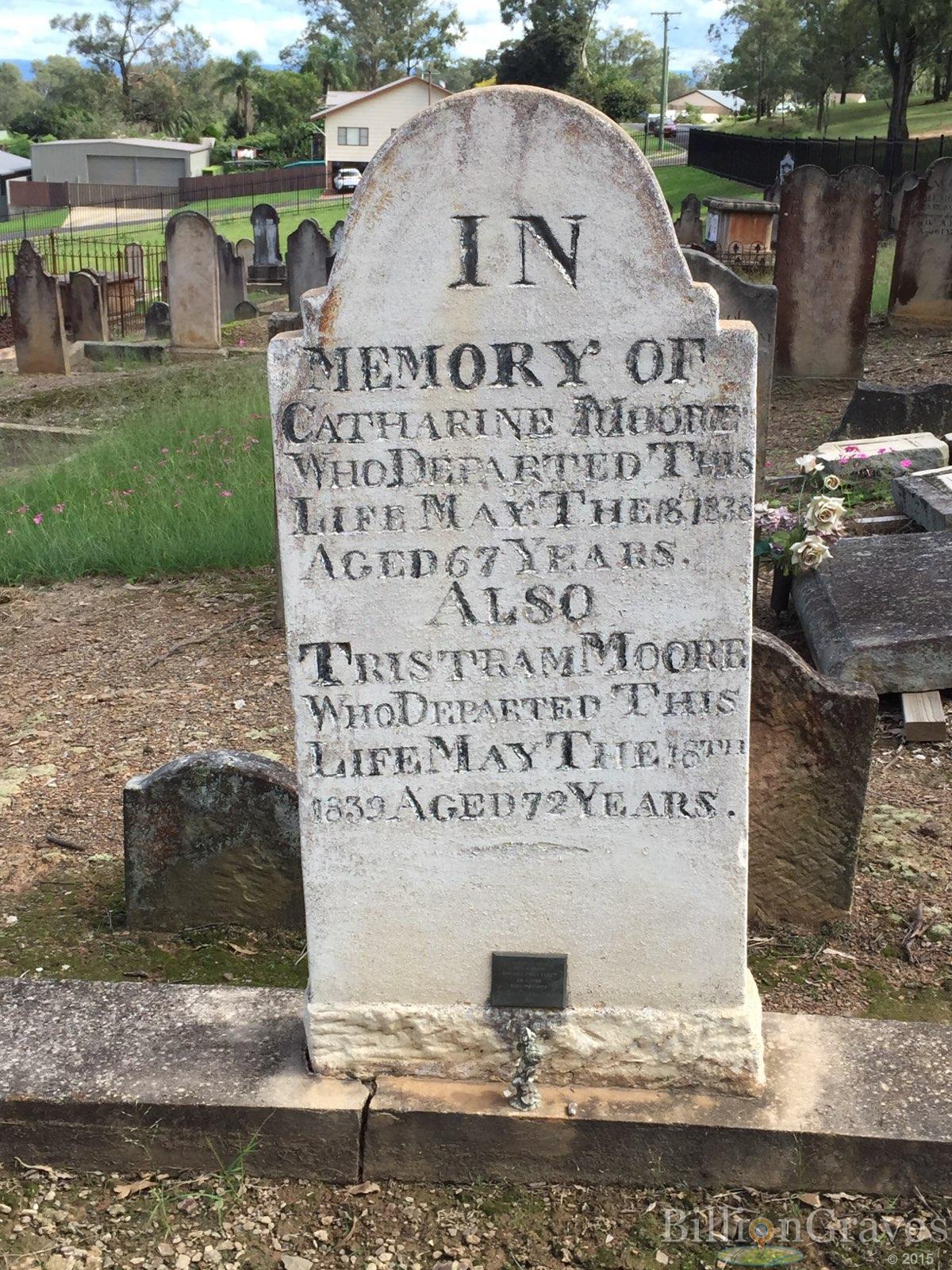
I have attached a photo of his grave at Wilberforce Cemetery in the Hawkesbury area of NSW. He partnered Catherine Johnson a convict from London in the First Fleet to Australia of 1788. He has many descendants in Australia from his first daughter Margaret Jane (married Bowd). His second daughter Mary Anne had no children. And his son Tristram died as an infant. Margaret was the name of Catherine's mother so it is possible that Mary was the name of Tristram's mother. He died a year to the date after Catherine and he was well considered in his community in the Hawkesbury.


