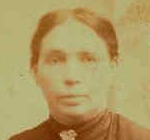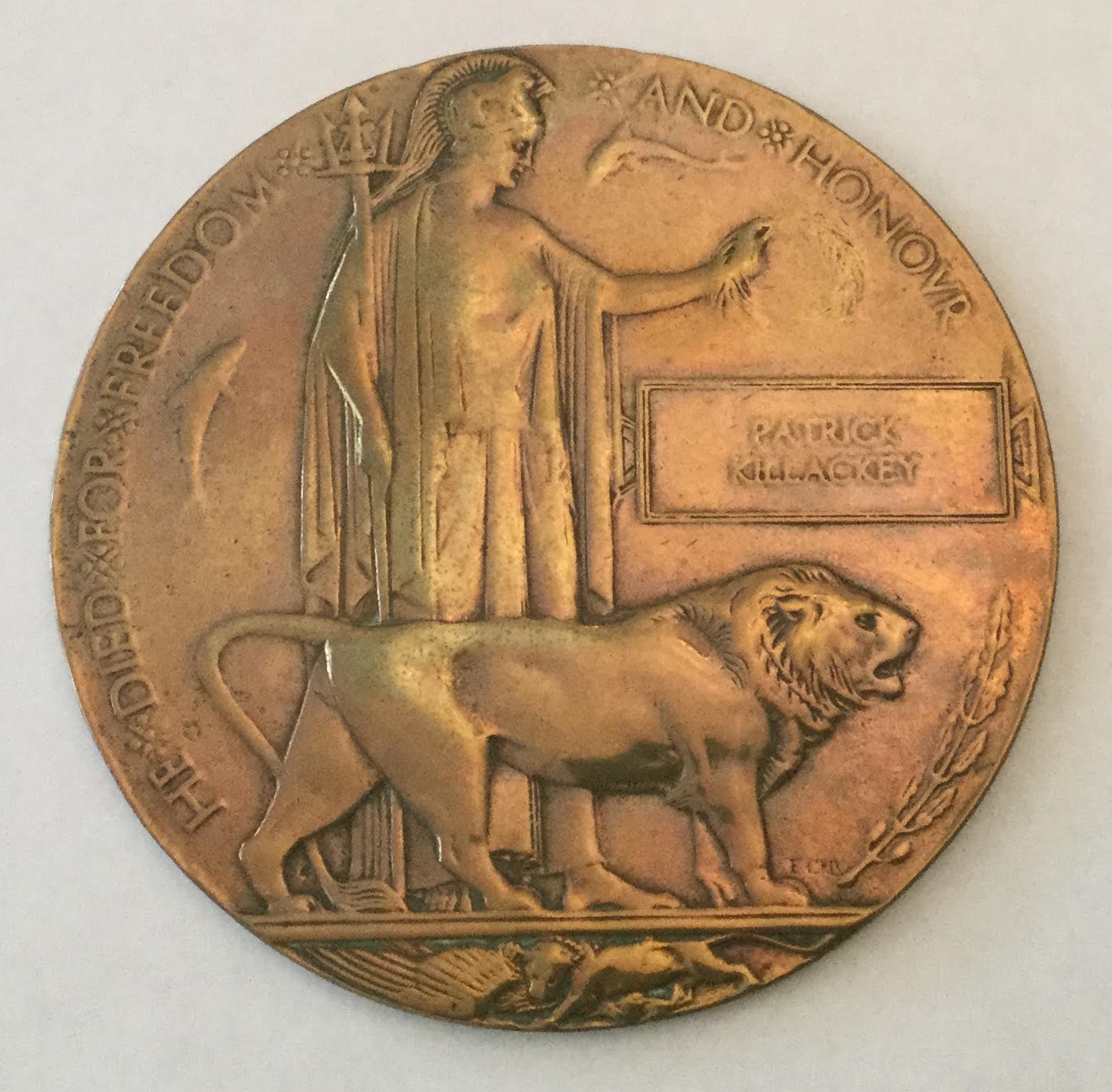
Patrick Killackey
- Born
- 1 Jan 1880
- Died
- 1 Jan 1917
- Gender
- Male
Patrick Killackey
Campaign Battle Date
None Armentières 1914 1914
Second Battle of Ypres Battle of Gravenstafel 22–23 April 1915
Battle of St. Julien 24 April – 4 May 1915
Battle of Frezenberg 8–13 May 1915
Battle of the Somme Bourlon Wood
Battle of Guillemont 3–6 September 1916
Battle of Ginchy 9 September 1916
Battle of Arras Battle of Vimy Ridge 9 – 14 April 1917
Third Battle of Ypres Battle of Messines 7 – 14 June 1917
Patrick Killackey died two days after the Battle of Messines ended, having fought at Ypres, The Somme, Vimy Ridge and Messines
Thomas Killacky (1834 - 1909)
2nd great-grandfather
Patrick Joseph Killackey (1880 - 1917)
son of Thomas Killacky
Barbara Mary Killackey (1903 - 1980)
daughter of Patrick Joseph Killackey
Eileen Fanning (1931 - )
daughter of Barbara Mary Killackey
Joe Abrams (1973 - )
Son of Eileen
Place born: Banagher, Kings County
Date born: 24 Jan 1880
Date died: 16 Jun 1917
Social class: Agricultural Labourer
Patricks father and his brothers Joseph and Thomas were in the army. Joseph survived the War and was in barracks when a census was taken immediately prior to the disbanding of the army; Thomas was killed in France in 1916. Patrick was born and grew up in a town dominated by the British Army. A regiment had been based there to recruit Irishmen from that part of Ireland. His family owed their living and adventures, in large part, to that Army. At a time when parts of Ireland and certain people in Ireland struggled economically and were entirely subject to the Landlord system for a living – the Killackeys had a different status by virtue of joining the army.
However, by the end of WWI – which Patrick didn’t see - this family would experience a new Ireland. Patricks generation (those who survived) would see the British Army removed from the Free State. The old regiments disbanded and the former association and service would become taboo for many years after the creation of the Irish republic. What did that mean for the status of this family? For how it was perceived by others and for the next generation (Patricks children for example) how did they see Ireland now? His brother (Joseph) Killackey was in barracks in Ireland in 1922, when the Leinster Regiment were disbanded. Their colours were accepted by the King at Windsor Castle in the same year.
It struck me, reading the histories of certain ‘Irish’ Regiments that the soldiers drawn from Ireland were held in great esteem by the Officers of those regiments. It seems that the British Army, for some, was a place were adventure, money and most of all respect as an Irish man could be gained. One of very few places in society where that was true for most Irish men at that time. That mix of financial security from a regular wage and pension and the esteem given to men who had ‘served’ must have been very appealing compared to other options.
Patrick worked in agricultural labouring and went in the Army. He was a ‘reserve’ at times, then doing service at other times. He was in the Leinster Regiment, 2nd Battalion. He joined when he was 18 years old and he died at 37 years old. He was approaching the 21 years service where he would have gained a pension. Unlike many soldiers of WWI, he was a career soldier, not a conscript.
His death, on June 16 1917, can be pinpointed by looking at the 2nd Battalions War Diaries held at the National Archives (Kew). These are de-classified documents and were the notes kept by officers in relation to troop movements. The notes are extensive and I have only copied in the beginning of June and then the first note in July. He was killed on, or close to, 16 June 1916. This was at the time the 2nd Battallion, Leinster Regiment (of which he was a part) were involved in the Battle of Messines. Having fought at Vimy Ridge, the Regiment had trained and then been moved to Messines. The battle is famous for the use, by the British, of tunnels to plant a huge amount of explosives under the German lines, when detonated on 7th June “nineteen huge mines were exploded under the enemy’s lines in the greatest artificial eruption which had ever shattered the earths crust”[1].
The lines I found of most likely connection to Patricks death were “the battalion found working parties to assist the 13th Middlesex and for construction of a new communication trench in which task many casualties resulted from a heavy bombardment (German Artillery). So passed the 9th and 19th June.” Patrick was either wounded in this bombardment or in an earlier stage of the battle, dying of his wounds a short time after the Leinsters were relieved. On the 11th June The Leinsters were relieved by the Fusilliers and returned to camp. Messines had been a success in terms of the battalions efforts. 17 killed and 84 wounded was seen as light in terms of casualties. Patrick was one of those killed.
The diaries below cut out during the actual Battle of Messines, they show the build up, the equipment and then the diaries stop and pick up again once it is over.
Patrick had a civilian life and was married to Mary Killackey. They lived at Pucha Lane, Banagher. The census showed that these buildings had outbuildings in which some along the street kept pigs. It was a small house, typical of an agricultural labourer of the era.
Mary moved to Manchester after the war and remarried, to Joe Manning, they lived in Salford, her daughter Bridget Killackey would later join her mother in Manchester, she had married and become Bridget Deegan. For a period she became Barbara (not Bridget) Manning and (much later) became Barbara Fanning (another story).
Further reading:
The History of the Prince of Wales Leinster Regiment (Royal Canadians). Part II The Great War and the disbandment of the regiment. Lieutenant Colonel Frederick Ernest Whitton. C.M.G
You can read more about the Leinsters at the battle of Vimy Ridge and Messines here:
https://en.wikipedia.org/wiki/Battle_of_Messines_(1917)
https://en.wikipedia.org/wiki/Battle_of_Vimy_Ridge
[1] Page 363-365. The History of the Prince of Wales Leinster Regiment (Royal Canadians). Part II The Great War and the disbandment of the regiment. Lieutenant Colonel Frederick Ernest Whitton. C.M.G