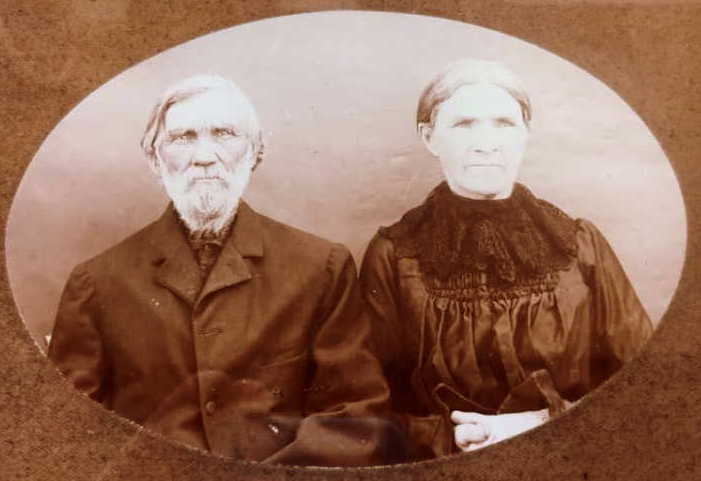
Martin Meany
- Born
- 1837-01-01 12:00:00
- Died
- 1900-06-06 12:00:00
- Gender
- Male
- Place of migration
- Migrated to/Born in Australia
My great grandfather Martin Meany (Meaney) was born in 1837 and was from the townland of Bolooghra in County Clare. His parents were John Meany and Mary Coughlan. The records for Killadysert catholic parish show that Martin was baptised on 2 May 1837.
His brother Daniel was baptised on 1 May 1840. There is no evidence of other siblings in the available baptismal records.
There is evidence of a family or families of Meany’s living in Bolooghra from the early 19th century. A John Meany, Michael Meany snr and Michael Meany Jr are mentioned as leasing land in Bolooghra in the 1821 freeholder lists and a Michael Meany is mentioned in Bolooghra in the 1824 tithe appointment books.
The Griffith Valuation (completed in Clare in 1855) mentions four Meany’s holding land in Bolooghra, Michael, James, John, and Timothy. The four Meany’s farm four plots which are contiguous with each other suggesting that these plots were possibly once part of the one holding which has been subdivided among the original farmer’s sons. Also, the Tenure Book for January 1854 indicates that these four Meany’s have held the four plots of land that are side by side on lease at will since 1836. Possibly the father was Michael Meany Snr referred to in the 1821 freeholder lists. Michael and James also both hold an additional plot in another area of the townland and these plots are also beside each other. These two plots are shown in the Tenure Books for January 1854 as being held on lease at will only since 1851. The four Meany’s have reasonable size farms, with Michael having the largest at 108 acres and Timothy the smallest at 24 acres. John farmed 30 acres.
The four Meany’s all married Coughlan’s, perhaps sisters or cousins. John was married to Mary Coughlan, Michael married Bridget Coughlan, James married Margaret Coughlan and Timothy was also married to a Bridget Coughlan, which suggests that some of these Meany wives were cousins rather than sisters.
Migration to Australia
Martin migrated to Australia around 1859 and travelled with a group of young men from the local area Thomas Mahon, James Kelly and Patrick Ayer.
His brother Daniel travelled to Australia just over a year later in November 1861.
After a stint in the Victorian goldfields, around 1862 both Martin and Daniel along with many other miners from the Victorian goldfields headed to the newly discovered gold fields on the South Island of New Zealand. Martin stayed there a few years and then returned to Australia where he settled in the gold mining town of Bendigo in the colony of Victoria.
There is no further evidence of Daniel Meany after this. Whether he stayed in New Zealand returned to Australia or even returned to Ireland is unclear.
Martin and Daniel were part of a broader group people from their local area who came to Australia settled in the Bendigo district. In February 1862 Daniel was a witness at the marriage of Bridget Corbett from the nearby Clare townland of Burrenfada at St Killian’s church in Bendigo.Her husband died in 1864 and Bridget remarried in 1866 also at St Killian’s with this time my grandfather Martin Meany as one of her witnesses.
Bridget’s parents were James Corbett and Mary Meaney. Bridget had travelled with a group from the local area, on the ship The Arabian, which had arrived in Melbourne in January 1862. Included in the group were Johanna Daly, John Meany, Patrick Egan, Bridget Mahon, John Coughlan and Thomas Daly.
Life in Australia
Martin married Catherine Brennan from Kilkenny in 1871 and together they had ten children including my grandmother Teresa Meaney. After a stint gold-mining, Catherine and Martin farmed for a number of years, then ran a pub in Bendigo, The Kilkenny Arms, and finally Martin worked in a produce store in Bendigo. He died on 6 June 1900 while undergoing an operation under chloroform to remove a damaged eye.