
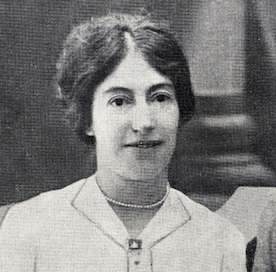
Margaret (née Gillespie) Cousins
- Born
- 1 Oct 1878
- Died
- 1 Mar 1954
- Gender
- Female
- Place of migration
- Migrated to/Born elsewhere
Margaret Elizabeth Gillespie, also known as Margaret or Gretta Cousins (1878–1954) is credited with composing the tune for the Indian National Anthem Jana Gana Mana. She was an Irish-Indian educationist, suffragist and Theosophist, who established All India Women's Conference (AIWC) in 1927. She served two terms in prison for suffrage in 1910 and 1913, and in 1932 she was imprisoned for supporting Gandhi.
Born and raised at Boyle, County Roscommon, Margaret Gillespie, to an Irish Protestant family, was educated later in Derry and the Royal University of Ireland in Dublin. Following her graduation in 1902 graduated she became a music teacher. As a student, she had met the poet and literary critic James Cousins, and moved in literary circles. She married him in 1903 and the couple explored socialism, vegetarianism, and psychical research together which ultimately led them to move to India in 1915.
READ MORE The Irish in India
In 1906, after attending a National Conference of Women meeting in Manchester, Cousins joined the Irish branch of the NCW. In 1907 she and her husband attended the London Convention of the Theosophical Society, and she made contacts with suffragettes, vegetarians, anti-vivisectionists, and occultists in London.
In 1908, Cousins co-founded the Irish Women's Franchise League with Hanna Sheehy-Skeffington and served as its first treasurer.
In 1910 she was one of six Dublin women attending the Parliament of Women, which attempted to march to the House of Commons to hand a resolution to the Prime Minister. After 119 women marching to the House of Commons had been arrested, 50 requiring medical treatment, the women decided to break the windows of the houses of Cabinet Ministers. Cousins was arrested and sentenced to a month in Holloway Prison.
Vacationing with W. B. Yeats in 1912, Cousins and her husband heard Yeats read translations of poems by Rabindranath Tagore. In 1913, breaking the windows of Dublin Castle on the reading of the Second Home Rule Bill, Cousins and other suffragists were arrested and sentenced to one month in Tullamore Jail. The women demanded to be treated as political prisoners, and went on hunger strike to achieve release.
In 1913, she and her husband moved to Liverpool, where James Cousins worked in a vegetarian food factory. In 1915 they moved to India and Margaret taught English at Madanapalle College.
-
In 1916, she became the first non-Indian member of the Indian Women's University at Poona. In 1917 Cousins co-founded the Women's Indian Association and edited the WIA's journal, Stri Dharma.
-
In 1919–20 Cousins was the first Head of the Mangalore National Girls' School.
-
In 1922, she became the first woman magistrate in India;
-
In 1927, she co-founded the All India Women's Conference, serving as its President in 1936.
In 1932, she was arrested and jailed for speaking against the Emergency Measures. By the late 1930s she felt conscious of the need to give way to indigenous Indian feminists:
I longed to be in the struggle, but I had the feeling that direct participation by me was no longer required, or even desired by the leaders of India womanhood who were now coming to the front.
A stroke left Cousins paralysed from 1944 onwards. She received financial support from the Madras government in recognition of her services to India. She died in 1954. Her manuscripts are dispersed in various collections across the world.
WORKS
-
The Awakening of Asian Womanhood, 1922
-
The music of Orient and Occident; essays towards mutual understandings, 1935
-
Indian womanhood today, 1941
-
(with James Cousins) We Two Together, Madras: Ganesh, 1950
READ MORE The Irish in India


