
Julia Mullins
- Born
- 1 Jan 1799
- Died
- 25 Jan 1869
- Gender
- Female
Julia Mullins was tried at the Old Bailey in London on 19 Sep 1818. She was from Cork and stated her age was 19. She was charged with ‘stealing 11/6 from the person’. Three gentlemen gave evidence against her, so it was her word against theirs. Her remarks when she was being taken down: ‘they are swearing my life away.’
According to Select Catholic Marriages 1775-1912 her parents were Daniel Mullins of Skull and Julia Shanahane of Bantry, Cork, married 20 Oct 1795.
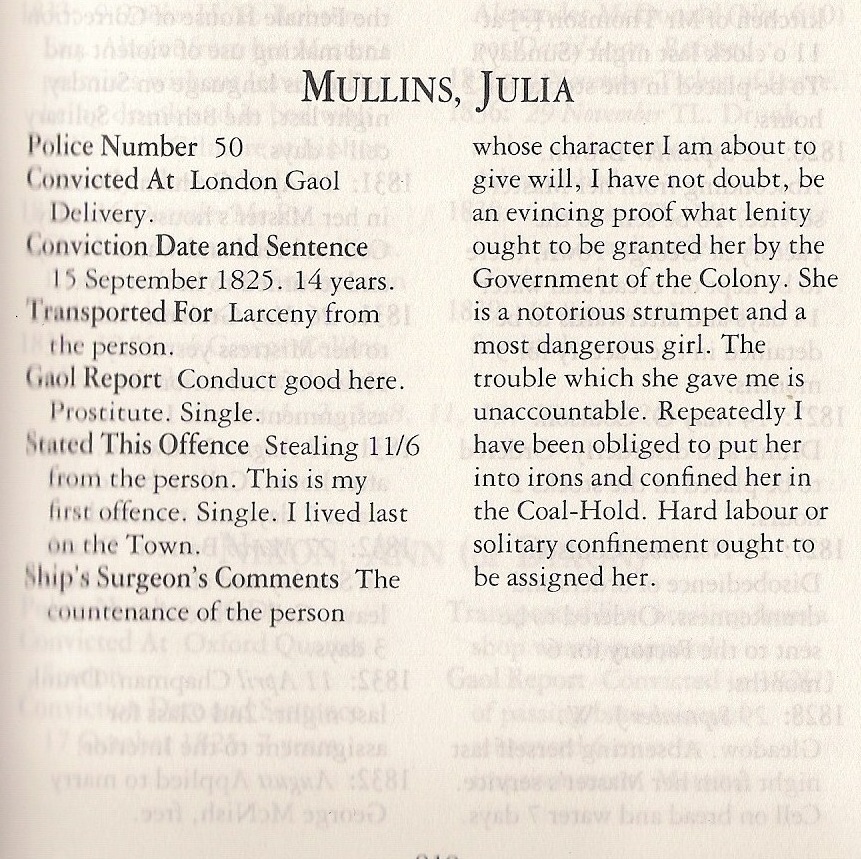
In her convict records, Julia was described as being aged 19 years, single, and a servant of all work who could wash, cook and work at her needle. She was listed as being 5' 3¾" tall, having dark brown hair, dark grey eyes, slightly pock pitted with a seam on her upper lip under her nose and scars on her forehead. She stated that she had been a common prostitute - lived on the town.
Julia was incarcerated for seven years before her transportation per the Providence, which commenced its second voyage to Van Diemen's Land on 24 December 1825, arriving 16 May 1826, under the command of Captain John Wauchope.
Her gaol report listed her conduct as good, though it noted she had been a prostitute.
The ship's surgeon commented:
The countenance of the person whose character I am about to give will, I have no doubt, be an evincing proof what lenity ought to be granted her by the Government of the Colony. She is a notorious strumpet and a most dangerous girl. The trouble which she gave me is unaccountable. Repeatedly I have been obliged to put her into irons and confined her in the Coal-Hold. Hard labour or solitary confinement ought to be assigned her.
It must be noted that this same surgeon cohabited with one of the female prisoners during the voyage and held drinking parties in his cabin with other female prisoners and ship's crew, as well as the captain. In her book ‘Selling Sex: A History of Prostitution’ Rae Frances refers to it and suggests Julia denied him sex.
It was the ship's surgeon's comments about Julia which inspired the title for Tardif's (1990) book, Notorious Strumpets and Dangerous Girls, which is a record of all female convicts sent to Australia.
After arrival in VDL Julia was initially being assigned to a female factory in Tasmania Julia was assigned to various masters and at times returned to various female factories. She was charged with many misdemeanours and punished constantly whilst a convict - sometimes for drunkenness.
Julia applied to marry twice and those applications were rejected, probably because she or the men in question didn’t have tickets of leave. She had several children (one called John to a John Robinson), with some dying and some unable to be tracked, prior to Peter's birth in 1837. DNA proves a family secret handed down that the father of her daughter Emily (b.1839) was Portuguese. The first record of Emily is a baptism at age 15, where she was using the name Emily HILL, her then step-father’s name (son Peter also took this surname). Unfortunately nothing can be found out about the Portuguese man, but we do know that Launceston, where Julia was living around the time of Emily’s birth, was a busy port swarming with sailors from all over the world.
Julia married Peter Hill, a Scottish convict on 23 Nov 1848. The first record tying Julia and Peter together is the Census in 1842, in Cleveland, south of Launceston, and the birth and death of an unnamed female child in November that year.
Son Peter who was born prior to Emily also took the name Hill. John was born and registered to Julia and Peter Hill in 1844. Life seems to have been quieter for her after settling with husband Peter in the Campbell Town district, although on 17 Nov 1851 she was fined for illicit brewing while living at the family home near Campbell Town.
Julia died on 25 January 1869 aged 65 years. She was listed as a farmer's wife.
As a result of her colourful life she is well regarded among genealogists and interested descendants these days, we all like to claim her.


