Edward Blanchfield
- Born
- 1792-01-01 12:00:00
- Died
- 1861-01-01 12:00:00
- Gender
- Male
In the 1800’s Ireland was in turmoil following the Penal Law years (1691 – 1793) and the Act of Union (1 January 1801). Tenant farmers were battling Protestant landlords, crops were failing and families were displaced from their homes.[1][2] These hard times drove people such as Edward Blanchfield to crime and unwittingly also a new life on the opposite side of the ocean.
In August 1815, in Waterford County Ireland, Edward Blanchfield was tried and convicted with Mathew Buckley, for stealing a watch and both sentenced to seven years transportation. [3] Convict documentation does not state clues to his parentage but include physical description of Height 5’ 10” ¼ dark sallow complexion, black hair, hazel eyes.
[1]History on the Net, ‘Northern Ireland Timeline’, https://www.historyonthenet.com/northern-ireland-timeline, Accessed 25 May 2018.
[2] Williams Adams, Ireland and Irish Emigration to the New World from 1815 to the Famine, Genealogical Publishing Co, 1980 books.google.com.au/books?id=ua6xqVQpr4EC&dq=waterford+ireland+1815
[3] Edward Blanchfield, Transport Record, 1816 Convict Arrivals, James McClelland 1985
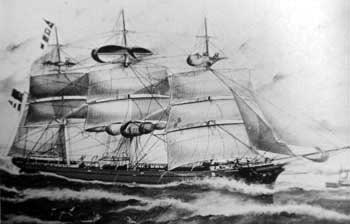
Governor Macquarie was introducing changes to the Sydney Cove colony when the Guildford arrived on 23 April 1816. His unpopular idea with free settlers, was that convicts after serving their time were to be treated as normal citizens, without any previous criminal record and believed that emancipist convicts were often the best settlers. [1]
[1] Garran Andrew (Edited), Australia The First Hundred Years, Summit Books, p26
Months later the arrival of Irish female pick pocket, Susannah Henderson (Lord Wellington, 20 January 1820), transported for seven years,[1] known as Susan Anderson. Months later, Edward applied to Governor Macquarie for them to marry, it was approved, the couple were married in St Philips Church Sydney on the 12 October 1820.[2] Their marriage formed the Australian roots of generations of descendants.
[1] Susannah Henderson, Transport Record.
[2] NSW State Archives, ‘Convicts Permission to Marry’, Microfilm Reel 1031, 4/3505
Their first son, William was born on the 16 February 1821 and baptised on 25 March 1821 at St Philips Church, Sydney
Edward and Susannah were living at Wooloomooloo on 8 February 1822, when they were assigned convict, Lucas Thomas, who remained with them until April 1823. In the September census, he was working as a labourer until December when he became a Constable in the Prisoner Barracks.
Their second son, Edward Jnr was born on the 3 March 1823[1] and also baptised at St Philip’s Church. Edward continued as a Constable at the prisoner barracks until 16 February 1824, when he was dismissed for improper conduct, does not denote why, but could not have been serious, as he was reappointed weeks later on 8 March 1825.
In August 1825, he applied for a land grant, stating he “wished to retire to the interior”, he was then granted 50 acres of land by Sir Thomas Brisbane in November and shows as Sydney landowner on the1825 Muster. [2]
Susannah obtained her Certificate of Freedom[3], weeks before their third child, a daughter, Frances Rosa was baptised by Reverend John Therry on the 13 November 1825.
[1] Church of England Baptism Register, St Philips, Sydney, NSW Archives, Microfilm, No. 571, Vol 8, Reel 5002
[2] News South Wales State Archives, Musters and other papers relating to convict ships. Series CGS 1155, Reels 2417-2428 (Reel 2422, Page 393 – Guildford)
[3] Susannah Henderson, Ticket of Leave, NSW State Archives
Edward and Susannah’s children married and raised families of their own. William and Rosa remained in New South Wales whilst Edward moved to Queensland, where he became a pioneering father and Mayor of the town of Allora, Queensland.
The gap in records continues until Susannah dies and is buried at St James Roman Catholic Church, on the 24th October 1852. The few records found to date, help fill some of his time, showing that life was difficult for Edward, following the death of his wife. Through the scant records, Edward appears to have remained living in the Cooks River area, a lonely destitute life as he aged.
On the 10 January 1861, Edward took his own life. A Coroner’s witness statement reported they had seen Edward come to the local inn, sell his knife to a bricklayer for 3d and bought a drink. The following morning he was found hanging by his kerchief (necktie) from a fig tree at Cook’s River. The cause of death listed that he was “impaired by the infirmities of old aged and destitution”. He was buried on 12 January 1861 in the Camperdown Cemetery.[1]
[1] ‘Suicide Edward Blanchfield, Sydney Morning Herald, 11 January, 1861, p 5.http://nla.gov.au/nla.news-article28626307