
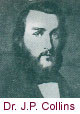
James Patrick Collins
- Born
- 1824-01-01 12:00:00
- Died
- 1847-07-01 12:00:00
- Gender
- Male
- Place of migration
- Migrated to /Born in Canada
Dr. James Patrick Collins (1824–1847) was the only son of Patrick Collins and Isabella Hughes and the eldest of four children.
In 1837 he emigrated to Canada with his family, settling in the city of Saint John, New Brunswick where his father worked as a grocer.
Showing an interest in the study of medicine, James (assisted by Dr George R. Peters, then superintendent of the St John Lunatic Asylum) went to Paris in 1844 and later London to study. Upon his return to Saint John two years later, Dr. James Collins opened a medical practice from his family’s residence on Mill Street, York Point in 1846.
On 24 Oct. 1846 Dr James Collins married Mary Quin (Quinn) in Portland, and they had one daughter.
In May 1847 a typhus epidemic broke out in North America, arriving with immigrants fleeing the potato famine in Ireland. By June 1847, the hospital sheds at the quarantine station on St John's Partridge Island, were overflowing into military tents. Many others in quarantine were still aboard famine ships queuing to disembark. Overwhelmed, the health officer in charge sought Dr Collins' help, and without hesitation, he joined Dr. Harding as a medical quarantine assistant on a salary of £50 a month. Collins' brothers-in-law, James and Edmond Quin, were priests supporting Irish immigrants and probably encouraged him to go there.
Collins played a prominent role in combating the disease at Partridge Island but within a month he and his colleague fell had contracted Typhus themselves. Young Dr. James Collins died a week later. More than 2,000 Irish immigrants died during the typhus epidemic of 1847.
His funeral procession, estimated at 4,000 persons, was said to have been the largest ever seen in Saint John. Several years later Collins’s body was moved to St Peter’s burial ground (near Fort Howe) and in 1949 it was placed in a common grave in St Joseph’s cemetery.
Today, a Celtic cross in his memory stands on Partridge Island in commemoration of his devotion and sacrifice.


