
Back to ancestor search
David Horan

David Horan

Died
1729-04-04 12:00:00
Gender
Male

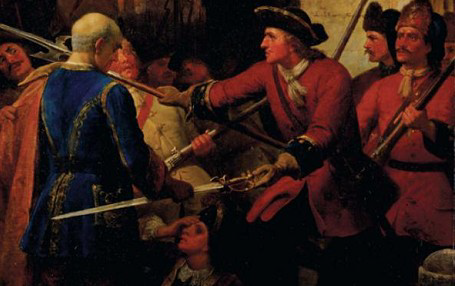
On 1 February 1702 the Battle of Cremona (Italy) between France and Austria took place during the ‘War of Spanish Succession’. Hundreds of Irishmen fought in French ranks that day, including Galway’s David Horan (Dillon Regiment), in what was ultimately an indecisive encounter. Horan would later have his right arm ampu-tated after being shot in subsequent fighting in Italy. It was while fighting in the Tyrol that Horan, who had been a Weaver at home, received his wounds. He did recover however, and he died at Mariembourg on the 4th April 1729. Pictured is an unattributed painting titled ‘Cremona, 1702’.
 

This Chronicle was created using information originally published in the South East Galway Archaeological and Historical Society Newsletter No. 26.
Associated communities

Galway

County Galway, Gaillimh in Irish, is located in the Province of Connaught in the West of Ireland. We have a population of approximately 232,000 and look forward to assisting you in the search for your Irish ancestors. 

Other ancestors in this community

Buildings in this community

  • Kilcooly Church Ruins & Cemetery

    Location: Galway

    Kilcooly, Co. Galway, Ireland

  • Portumna Irish Workhouse Centre

    Location: Galway

    St Brigid's Road, Portumna, Galway, H53 EK74, Ireland

  • Portumna Friary

    Location: Galway

    Portumna Demesne, Co. Galway, Ireland

  • Portumna Castle & Gardens

    Location: Galway

    Portumna Demesne, Portumna, Co. Galway, Ireland

Timeline events in this community

  • 1830s

    Kilcroan in 1837

    <p>As described in Samuel Lewis' <em>Topographical Dictionary of Ireland</em> 1837.</p>

    1837-01-01 12:00:00

  • 1820s

    First Census of Inisheer

    <p>The 1821 Census of Inisheer survived the Public Records Office fire. </p>

    1821-04-01 12:00:00

  • 1820s

    First Census of Inishmaan

    <p>The 1821 Census of Inishmaan survived the Public Records Office fire. </p> <p>Family names featured: </p> <p>Beaty</p> <p>O'Brien</p> <p>Callaghan, Callaughan, Collaughan</p> <p>Carey, Keaghry </p> <p>Clancy</p> <p>Concannon</p> <p>Connor</p> <p>Conneely (Connolly)</p> <p>Cook</p> <p>Costelloe</p> <p>Curreen</p> <p>Collins</p> <p>Dignum</p> <p>Dirrane (Derrane)</p> <p>O'Donnell</p> <p>Faherty</p> <p>Flaherty</p> <p>Fitzgerald</p> <p>Flemon (Fleming)</p> <p>Folan</p> <p>Ginnane</p> <p>Glinn (Glynn)</p> <p>Grealish, Grelish</p> <p>Griffy</p> <p>Higgins</p> <p>Joyce</p> <p>Kane, Kean, Kine</p> <p>Keating</p> <p>King</p> <p>Linnane</p> <p>Maher</p> <p>McDonough</p> <p>Mulkern (Mulkerrin)</p> <p>Murry (Murray)</p> <p>Prendergast</p> <p>Scahill</p> <p>Sullivan</p> <p>Welch</p> <p> </p>

    1821-04-01 12:00:00

  • 1830s

    Arranmore, Ennismain and Innishere in 1837

    <p>As described in the "Topographical Dictionary of Ireland" by Samuel Lewis, 1837</p>

    1837-01-01 12:00:00