
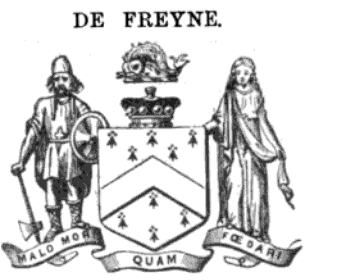
Arthur French
- Born
- 1 May 1788
- Died
- 29 Sept 1856
- Gender
- Male
Constituency
Dates
16 Jan. 1821 - 1832
Family and Education
b. ?May 1788, 1st s. of Arthur French I* and Margaret, da. of Edmund Costello of Edmonstown, co. Mayo; bro. of Patrick Fitzstephen French†. educ. Trinity, Dublin 3 June 1806, aged 18; Trinity, Oxf. 27 Apr. 1808, aged 19. m. 16 Apr. 1818, Mary Catherine, da. of Christopher McDermott of Creggah, King’s Co., s.p. suc. fa. 1820; cr. Bar. De Freyne of Artagh 16 May 1839; Bar. De Freyne of Coolavin with spec. rem. to his bros. 5 Apr. 1851. d. 29 Sept. 1856.
Offices Held
Gov. co. Roscommon 1821-31, ld. lt. 1854-d.
Biography
French, whose first cousin, and not he, was the Dublin barrister of that name,1 succeeded to his father’s extensive Roscommon estates, with an annual rent roll of £18,000, in November 1820 and to the family seat for the county at an uncontested by-election early the following year.2 His votes for inquiry into the conduct of the sheriff of county Dublin over the Queen Caroline affair, 22 Feb., and Catholic relief, 28 Feb., were praised at a Roscommon dinner in honour of his Whig brother-in-law Daniel Kelly of Cargins, 8 Mar. 1821.3 But French, who divided against Maberly’s motion on the state of the revenue, 6 Mar. 1821, for several years followed his father’s example as an inactive supporter of the Liverpool administration and sought government patronage for his relatives as the price of that backing.4 He commented on Irish education, 10 July, and, since in August 1821 he signed the requisition for a Roscommon meeting on the distressed state of his county and attended another on this the following year, it was probably he who thanked the English for providing relief for the West of Ireland, 30 July 1822. However, interventions on tithes, 15 May, 19 June 1822, may have been by his fellow Irishman Colonel Trench, Tory Member for Cambridge, with whom he was sometimes confused in the parliamentary records.5 He sided with opposition in its majority for abolition of one of the joint-postmasterships, 2 May 1822, but divided against inquiry into chancery administration, 5 June 1823. He voted for inquiry into the state of Ireland, 11 May 1824. He divided against ministers on the Irish unlawful societies bill, 15, 21, 25 Feb. 1825. He voted for Catholic relief, 1 Mar., 21 Apr., 10 May, but against the related franchise bill, 26 Apr. He attended a meeting of the Catholics of county Roscommon in October 1825 and brought up their petition, 1 May 1826.6
French was returned unopposed at the general election that summer, when he proved very popular with the Catholic freeholders, whose meeting he again attended, 9 July 1826.7 He voted for relief, 6 Mar. 1827. He divided for the committal of the duke of Clarence’s annuity bill, 16 Mar., but with the protectionists against the corn bill, 2 Apr. 1827. He voted for repeal of the Test Acts, 26 Feb., and Catholic relief, 12 May 1828. Although he chaired the county meeting to address the departing lord lieutenant Lord Anglesey, 31 Jan., the following month he was listed by Planta, the Wellington ministry’s patronage secretary, as likely to be ‘with government’ and he duly voted for Catholic emancipation, 6, 30 Mar., and to allow Daniel O’Connell to take his seat unimpeded, 18 May 1829.8 He was in the minority against the bill to raise the Irish county franchise qualification, 19 Mar. 1829, and later that year his uncle George was removed as assistant barrister of Roscommon because of the conflict of interest that would arise through his supervising the new registration of freeholders.9
Outvoted at the meeting got up by his colleague Robert King’s father, the Orangeman Lord Lorton, on the disturbed state of the county, 19 Nov., he convened another to express opposition to the proposal to invoke the Insurrection Act, 15 Dec. 1829. He signed the requisition for and moved the first resolution at the Roscommon meeting against the introduction of poor laws to Ireland, 30 Mar., and lodged this petition, 17 May 1830.10 That year he usually joined in the opposition campaign for economies and tax reductions, although he was apparently in the majority against Hume’s amendment to reduce judges’ salaries, 7 July. He divided with O’Connell for abolition of the Irish lord lieutenancy, 11 May, information on the Doneraile conspiracy, 12 May, making Irish first fruits no longer nominal, 18 May, and repeal of the Irish Vestries Act, 10 June. He voted for abolition of the death penalty for forgery, 7 June, and against the administration of justice bill, 18 June. Well regarded by his constituents, he was in no danger at the general election that summer, when he was returned in conjunction with a leading local Catholic gentleman, the O’Conor Don, after nothing came of a threatened opposition. He joined the revamped Roscommon Election Club in August 1830 and the following month attended the celebrations of the county’s independents.11
Listed by Pierce Mahony† among the ‘neutrals’ and by ministers among their ‘foes’, French was absent from the division on the civil list that led to Wellington’s resignation, 15 Nov. 1830. He wrote to Lord Brougham, the new chancellor, 25 Dec. 1830, suggesting that, as he took ‘an interest in this unlucky country’, he might wish to rectify abuses in Irish chancery administration.12 He divided for the second reading of the Grey ministry’s reform bill, 22 Mar., and against Gascoyne’s wrecking amendment, 19 Apr. 1831. Despite promising merely to maintain his consistent parliamentary conduct, he was returned slightly ahead of his colleague in a contest against an anti-reformer at the subsequent general election.13 He voted for the second reading of the reintroduced reform bill, 6 July, at least twice against adjourning proceedings on it, 12 July, and steadily for its details. He divided against the grant for civil list services, 18 July, and to print the Waterford petition for disarming the Irish yeomanry, 11 Aug., but for the Irish union of parishes bill, 19 Aug. He was in the ministerial majorities to punish those guilty of bribery at the Dublin election and against censuring the Irish administration over it, 23 Aug. (although he was also included in the minority on the latter division). He voted for the third reading, 19 Sept., and passage of the reform bill, 21 Sept., the second reading of the Scottish bill, 23 Sept., and Lord Ebrington’s confidence motion, 10 Oct. 1831.
Having in December 1831 signed the requisition for a reform meeting in Roscommon, which he apparently did not attend, he presented its petition for making the alterations in Ireland as extensive as those proposed for England, 3 Feb. 1832.14 He divided for the second reading of the revised reform bill, 17 Dec. 1831, the disfranchisement clauses, 20, 23 Jan., its details again, and the third reading, 22 Mar. 1832. He sided with government against producing information on Portugal, 9 Feb., but voted to restore the salary of the Irish registrar of deeds, 9 Apr., and, except when he divided for Crampton’s amendment that day, he was frequently in small minorities for making ministers’ Irish tithe reforms more extensive. He voted for Ebrington’s motion for an address calling on the king to appoint only ministers who would carry the reform bill unimpaired, 10 May, and the second reading of the (in fact quite limited) Irish bill, 25 May, but for increasing the county representation of Scotland, 1 June, and O’Connell’s amendment to enfranchise Irish £5 freeholders, 18 June. Apart from one for making coroners’ inquests public, 20 June, his only other known votes were with ministers for the Russian-Dutch loan, 26 Jan., 12, 16 July. Deeply wounded by having been passed over for the lord lieutenancy of Roscommon the previous year, when Lorton had been appointed, he announced his retirement at the following dissolution, confessing that ‘I cannot reconcile myself to support men who have treated me so badly, and I am determined private feeling shall never influence my public conduct’. On the hustings in December 1832, the new O’Conor Don* declared that, although he had been mostly silent in the Commons, ‘his name stands enrolled on the side of freedom and of justice and of Ireland, in every division early or late, anticipated or unexpected’, and in March 1833 the county approved an address of thanks to him at a special meeting.15
French was replaced by his younger brother Fitzstephen French, Liberal Member for Roscommon until 1873, who in 1833 exasperated Edward Littleton*, the Irish secretary, by using the grievance about the lord lieutenancy to demand further preferment for the family; pressure was later applied for a compensatory peerage.16 A barony was awarded in 1839, when the spurious antiquity of the title was allowed on the basis of French’s claim to be the seventeenth in lineal descent from Fulco De Freyne, whose family sprang from the 1st duke of Normandy.17 As by the mid-1840s De Freyne was a childless widower, the title looked likely to become extinct, and O’Connell asked Lord John Russell’s* government to fulfil the promise effectively evaded by Lord Melbourne, urging (not entirely accurately as to the Frenches’ parliamentary service)
how suited this family is to a permanent peerage. There is the singular fact that for upwards of 160 years this family has represented their native county and that without intermission, always voting for the Liberal or Whig interest and being amongst the most active and continuous supporters of Catholic emancipation. They have more than once refused a peerage when offered by unfriendly parties, by parties adverse to the interests of Ireland. Lord Grey’s government certainly treated the family very badly in appointing Lord Lorton, a virulent enemy, to the lieutenancy of the county instead of the then Mr. French, a steady supporter.18
Under the special remainder of the second creation, which was eventually granted in 1851, the 1st baron, who had become a member of Brooks’s in 1840, was, after his death in September 1856, succeeded in turn by his brothers, the Rev. John (1788-1863), rector of Grangesilvia, county Kilkenny, and Charles (1790-1868), an army officer, through whom the title continued.
Ref Volumes: 1820-1832
Author: Stephen Farrell
Notes
- 1. Al. Ox. 1715-1886, ii. 495; King’s Inns Admission Pprs. ed. E. Keane, P.B. Phair and T.U. Sadleir, 178.
- 2. S. Gibbon, Recollections (1829), 165; Dublin Evening Post, 2 Dec. 1820, 23 Jan. 1821.
- 3. Dublin Evening Post, 15 Mar. 1821.
- 4. Black Bk. (1823), 156; Session of Parl. 1825, p. 464; Add. 37301, f. 67.
- 5. The Times, 11 July 1821, 31 July 1822; Dublin Evening Post, 1 Sept. 1821, 18 June 1822.
- 6. Roscommon and Leitrim Gazette, 22 Oct. 1825; The Times, 2 May 1826.
- 7. Roscommon and Leitrim Gazette, 24 June, 22 July, 5 Aug. 1826.
- 8. Roscommon Jnl. 7 Feb. 1829.
- 9. Ibid. 11 July 1829.
- 10. Ibid. 21 Nov., 12, 19 Dec. 1829, 27 Mar., 3 Apr. 1830.
- 11. Roscommon and Leitrim Gazette, 24, 31 July, 7, 14 Aug.; Dublin Evening Post, 5, 10, 19 Aug., 25 Sept. 1830.
- 12. Brougham mss.
- 13. Dublin Evening Post, 5, 28 May; Roscommon and Leitrim Gazette, 14, 21 May 1831.
- 14. Dublin Evening Post, 24 Dec. 1831, 7 Jan. 1832.
- 15. Ibid. 8 Dec.; Roscommon Jnl. 21 Dec. 1832, 15 Mar. 1833.
- 16. Three Diaries, 354-5; O’Connell Corresp. vi. 2430.
- 17. J. D’Alton, Mem. of Fam. of French, 44; CP, iv. 114-15.
- 18. O’Connell Corresp. viii. 3256.


